
1. Introduction
Australia’s military airbases serve as essential components of national defence. These bases provide crucial capabilities for rapid air mobility and enable force projection while enhancing homeland security and supporting joint and coalition operations. Enhancing the resilience of Australia’s northern RAAF bases is essential to achieving the strategic objectives outlined in the 2024 National Defence Strategy (NDS) and 2024 Integrated Investment Program (IIP). The term resiliency is mentioned over 20 times in the NDS with a specific focus on enhancing survivability of our northern bases to defend our northern approaches (Department of Defence, 2024b). The NDS states and directs that enhancing resilience be one of the IIP’s six immediate priorities (Department of Defence, 2024b, p. 38). The IIP has dedicated $14-18 billion (out to 2034) to enhance our northern bases (Department of Defence, 2024a, p. 87). This money is separate to the billions of dollars which are also allocated to airbase operations through more resilient command-and-control networks and improved theatre logistics. Therefore, Defence needs to take action to enhance airbase resilience and survivability. This paper seeks to provide further argument to support this line of effort, provide specifics on how to enhance airbase resilience, and discuss some of the challenges that Defence needs to overcome.
The paper focuses on Australia’s northern airbases, as the challenges for enhancing survivability in an era of uncertainty are most acutely felt. These bases include RAAF Darwin, Tindal, Curtin and Learmonth. The paper is set out in four sections. First, it will introduce key concepts and definitions regarding airbases, their resilience and contribution to national defence. Second, it will discuss key strategic challenges facing Australia’s military airbases; this includes geographic isolation, climate threats and strategic uncertainty. Third, it will outline the five key elements to build resiliency: infrastructure hardening, operational dispersal, rapid recovery, community and family resilience, and exercising. Fourth, it will synthesise all these points into a case study on RAAF Base Tindal which demonstrates Australia has the capability to build greater airbase resilience across the country.
2. Key concepts and definitions
The joint force and Air Force has a significant amount of doctrine on air power, airbases and airbase resilience. Defining, understanding and applying these terms is key to grounding any argument about enhancing our airbase resilience and improving our national security. This paper seeks to apply these terms to our current circumstances and use a specific case study to argue that we need to widen our understanding of resilience to incorporate concepts such as civilian preparedness, community support and cohesion.
-
Airbase. The ADF Air Power Integration doctrine defines an airbase as ‘A defined area containing an aerodrome and infrastructure that supports air power activities’ (Air and Space Power Centre, 2023, p. 50).
-
Airbase Operations. There are several roles that an airbase performs and not all of RAAF’s airbases function to the same level of capability. The spectrum spans from a main operating base (MOB) that provides the infrastructure and services for hosted units to conduct training, operations and maintenance support, forward operating base (FOB) from which air missions are launched in support of the joint force and down to a landing zone, the specific area of land or landing deck for rotary winged aircraft (Royal Australian Air Force, 2022, pp. 4–6). This paper defines RAAF Darwin as Australia’s MOB in its northern approaches and RAAF Curtin, Learmonth, Tindal, Townsville and Scherger as FOBs. Other MOBs in Australia include RAAF Amberley, Edinburgh, Richmond and Williamtown; however, the primary focus of this paper will be looking at Australia’s northern airbases.
-
Airbase Functions. Air Force’s Air Power Manual states that ‘the level of support provided to an airbase will differ depending on the type and location. The contribution to joint effects provided by airbase operations will be made up of one or more of the following airbase functions’: command and control (C2), airbase protection, operations support, logistics support, aerodrome engineering, health support, safety, network operations and emergency response (Royal Australian Air Force, 2022, pp. 4–5, 4–7)
-
Airbase Dependence. Air power, distinct from other forms of military power, is highly dependent and reliant on other capability and support systems to enable the generation, employment and sustainment of military power. The Air Power Manual outlines that ‘this level of dependency typically requires an established airbase … which [relies] on a complex supply chain’ (Royal Australian Air Force, 2022, pp. 3–5). A key component of this supply chain is a reliance on civilian infrastructure, including emergency services. Furthermore, Australia must overcome difficulties regarding airbase defence and continuity planning. Due to its geographic layout, Australia has military bases distributed over large areas, usually far from population centres. Geographic isolation creates logistical challenges and lowers redundancy levels while extending emergency response times.
-
Airbase Resilience. Given today’s strategic demands, airbases must enhance resiliency, which is essential to their survival. The ADF defines airbase resilience:
Airbase resilience is the ability of an airbase or network of airbases to withstand an attack or other adverse event, continue to perform essential functions while degraded, and to recover. Resilience pertains to facilities and infrastructure design and maintenance, workforce training and organisation, command and control (C2) and major systems (Australian Defence Force, 2022, pp. 83–84).
Resilience goes beyond technical and engineering tasks. It requires a change in culture, ongoing leadership focus and continuous investment. Achieving resilience demands interagency coordination between military and civilian organisations and moving from a mindset of safe havens to preparing for contested spaces. This paper investigates Australian military airbases’ main difficulties while identifying essential resilience-building areas, explaining methods to test these enhancements, and discussing the practical challenges that need resolution.
3. Key challenges facing Australian military bases
Developing resilience at Australian military airbases is a multi-faceted undertaking that involves more than creating plans and investing in infrastructure enhancements. Building resilience for Australian military airbases demands continuous collaborative efforts that affect every part of the base and extend over a lengthy period.
3.1. Geographic isolation
Historically, geographic isolation has been a factor that has enhanced airbase survivability. Strategic requirements, as well as historical factors, have resulted in many northern airbases being situated in isolated and thinly populated regions. Historically, this has been a factor that enhanced airbase survivability; however, in the age of long-range precision strike weapons and the emergence of cyber and space threats, this advantage has been eroded.
RAAF Curtin, Darwin and Learmonth stand hundreds to thousands of kilometres distant from key population areas and logistical networks and have limited immediate support (Royal Australian Air Force, n.d.). The isolation means that these airbases suffer from extended supply chains. The civilian infrastructure around medical facilities, airports and road networks often lacks the capacity to sustain surge operations. Transport routes add further vulnerability, as single highways and ports form long, narrow logistics lines that can be disrupted during wars or natural disasters (Parliament of Australia, 2020). During emergencies, the arrival of reinforcements, emergency repair teams and even basic supplies can take several days.
Australia’s distinctive geography creates additional barriers to developing resilience capabilities. Effective resilience requires defence collaboration with civilian authorities, contractors and local governments through partnerships that can lack strength or prior establishment – especially outside of our MOBs and FOBs. Resilience planning should include clear thresholds for transitioning from Defence Assistance to the Civil Community (DACC) to combat posture, with rehearsed handover points to civilian agencies.
The natural protection against opportunistic attacks that isolation provides, comes with the challenge of sustaining high-tempo operations, especially when the base sustains damage. Self-sufficiency for long-term resilience requires bases to focus on fuel storage capacity, onsite maintenance capabilities, water security systems and medical service availability. Military installations need to practise functioning independently while receiving minimal outside assistance. Innovative approaches such as prepositioning, distributed logistics hubs, modular fuel systems and uncrewed logistics drops are required to reduce the practical effects of isolation.
3.2. Climatic extremes
Australia’s northern bases face, at an increasing rate, extreme weather events. These events undermine the endurance of airbases. The events include tropical cyclones, extreme heat and storms – all of which are exacerbated by their remoteness. For example, RAAF Darwin and Tindal in the north endure yearly cyclone seasons, which bring dangers that disrupt various airbase functions. The effects include wind damage to buildings which can impact on logistics and C2, flooding which can impact runway and maintenance operations and high temperatures which can overwhelm operational cooling systems and test personnel’s physical limits. Climate change projections show that environmental pressures will become stronger, leading to higher baseline stress on military infrastructure (Department of Defence, 2024b, p. 14).
Researchers predict that climatic hazards will occur more often and intensify throughout the upcoming decades. To strengthen against climatic extremes, we need both strengthened physical infrastructure and flexible contingency approaches. Design of bases should account for extreme environmental situations that may include cyclone-proofed structures; critical facilities require both fire breaks and suppression systems to prevent fire damage, as well as elevated and flood-resilient fuel and supply storage, backup water supplies and airfield drainage systems.
3.3. Strategic threats
Australia’s strategic environment is deteriorating, bringing into sharper focus some of the potential military threats we may face. Consequently, airbases must enhance their physical and cyber security to enhance survivability. Australia’s airbases confront growing threats from targeted physical and cyber-attacks and can ‘no longer rely upon distance for protection’ (Australian Defence Force, 2022, p. 84). Some countries in the region have advanced technical and kinetic capabilities, such as precision long-range missiles that have the capability to attack stationary facilities such as airbases. These attacks can now occur at extremely long ranges of hundreds to thousands of kilometres (Layton, 2021; Needham, 2024). To counter this threat, the Integrated Air & Missile Defence System (IAMDS) could enhance base protection against precision strikes by providing layered warning, cueing and intercept capabilities. The conflict in Ukraine has shown the impact low-cost uncrewed aerial systems (UAS) will have on modern conflict. These UAS pose a new threat and can be launched within or outside Australian territory. This means that Defence needs to implement improved physical and electronic warfare security systems to counter UAS threats.
The cyber domain will increasingly impact airbase operations. Airbases face complex attack surfaces, as they depend on hundreds of IT systems that were not originally designed to withstand disruptions. Third-party dependencies also create vulnerabilities, since civilian suppliers and contractors may introduce weaknesses that provide unauthorised access points. Cyber intrusions and sabotage can compromise command-and-control systems, air traffic control, logistics management systems and fuel distribution networks (Kilcullen, 2023). Moreover, information operations are an emerging threat where base functionality can be undermined through civilian access disruption, dependent-targeted disinformation, and psychological operations without direct physical attacks. In addition, grey-zone activities, such as undercover sabotage accompanied by insider threats can incapacitate a military base during periods without an official war declaration (Kilcullen, 2023). Cyber resilience requires ongoing maintenance and is frequently overlooked (Kilcullen, 2023).
The contemporary nature of warfare renders our traditional concepts of security through geography and ‘rear area security’ obsolete. Bases should operate under the assumption that they will face immediate targeting during any upcoming conflict. This drives a requirement for movement and distribution of vital resources like aircraft and fuel and demand for robust command-and-control systems. It also requires redundant, hardened command-and-control systems. Most importantly, base operations should include permanent cyber defence teams to defend localised systems in the same way that intelligence teams are embedded at the base level. These cyber defence teams must complement component, theatre and national level defences.
4. Five priority elements for building airbase resilience
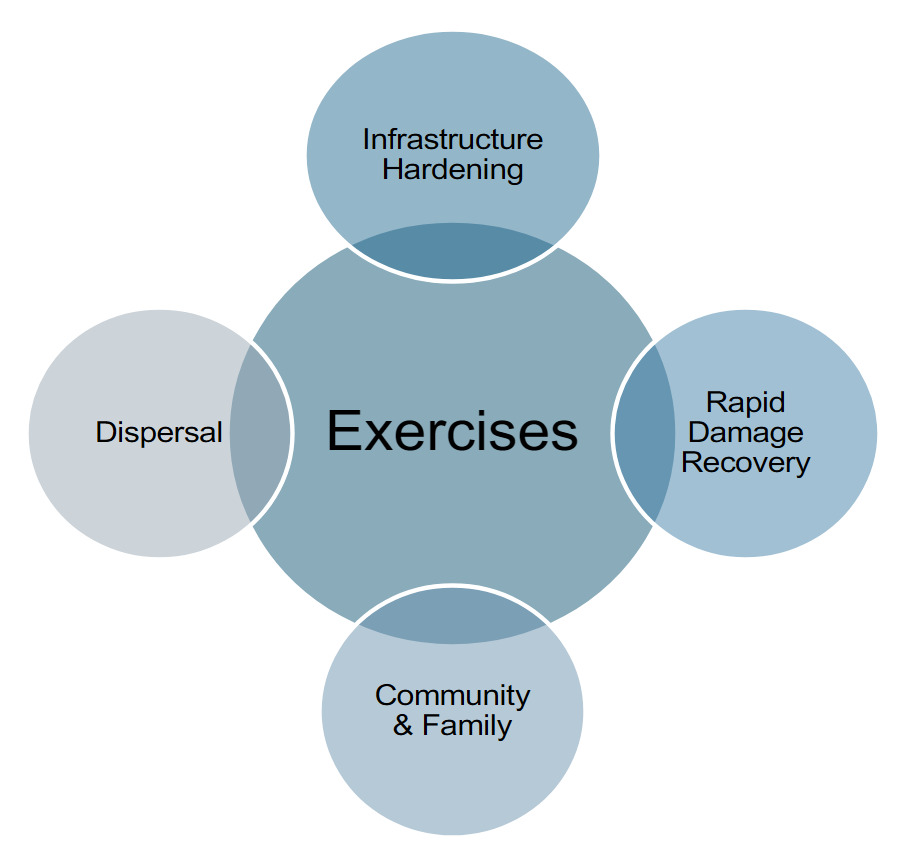
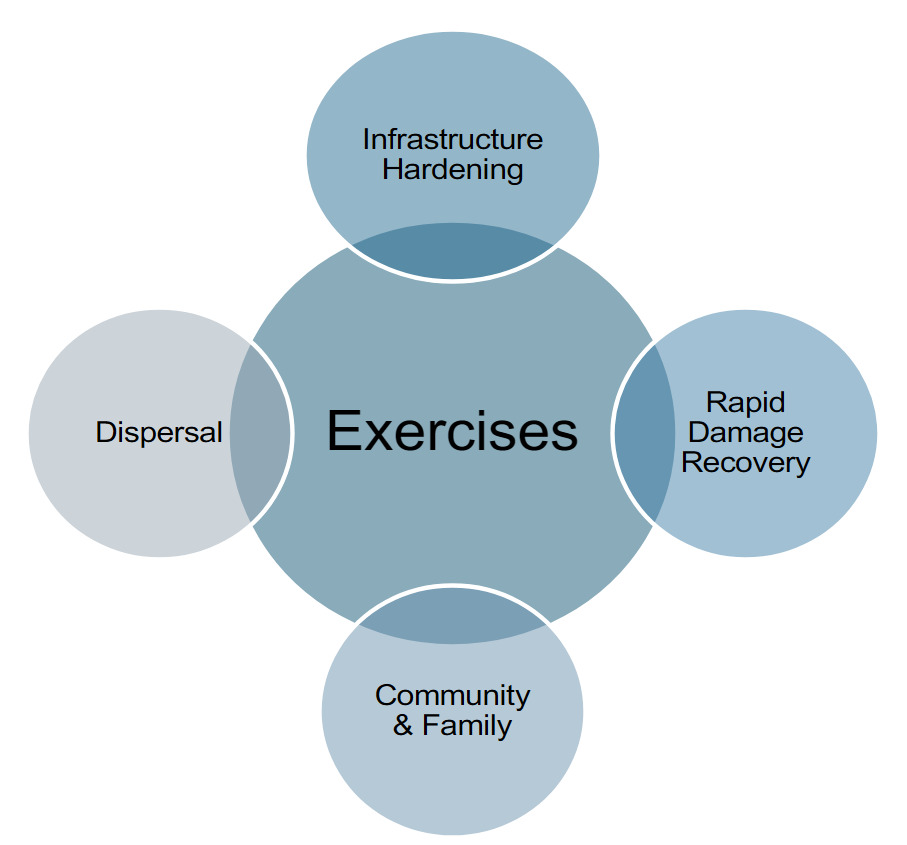
This paper argues that there are five areas that Defence should prioritise to build airbase resilience: infrastructure hardening, dispersal, rapid damage recovery, community and family, and exercising and validation. Each element is mutually supporting and enabled by continual exercising. A framework is in Figure 1. This paper acknowledges that there are other frameworks, such as the ADF’s components of airbase resilience, that can be used (Australian Defence Force, 2022). However, the framework provided in this paper provides practical initiatives commanders can take and aligns them to the NDS and IIP. It aims to provide specific examples and case studies to enhance doctrine and SOPs, which already form the conceptual basis for airbase resilience.
4.1. Infrastructure hardening
The ADF recognises physical infrastructure as a critical airbase capability and it has been prioritised in both the NDS and IIP. Therefore, physical infrastructure also stands as a critical, and in this paper’s assessment primary, defence layer in every resilience strategy. The ability to sustain operational functionality during environmental or targeted threats defines the resilience of Australian airbases. Infrastructure designs should support multi-role use, including the re-tasking of facilities for medical, logistics or humanitarian roles under contingency conditions; for example, gymnasium floors that can double as emergency accommodation. Resilience benefits from the standardisation and replication of essential systems across all bases, which provide functional redundancy, cross-base logistics and cross-base training to personnel.
Practically and financially, budget constraints and the long lead time for infrastructure improvements delay resilience building upgrades. The creation of hardened shelters, dispersed operating sites, mobile command posts and backup energy grids requires substantial financial investment, yet these projects rarely deliver quick or visible benefits. Budget constraints and high up-front costs often force decision-makers to prioritise the acquisition of new aircraft and weapons systems over resilience measures. The steps taken in the IIP are important to remediating this historical shortcoming.
Infrastructure hardening should aim to protect essential resources such as aircraft, fuel storage and command centres from physical harm. It should also aim to maintain essential airbase power, communications and medical functions after an attack or disaster. Most importantly, the system should be able to deploy deliberate damage mitigation strategies alongside repair mechanisms to ensure quick recovery after attacks or disasters.
Infrastructure hardening entails hardened aircraft shelters (HAS). HAS is essential to store aircraft in reinforced structures that can endure near-miss missile strikes, shrapnel and blast overpressure. HAS designs must also protect against regional environmental dangers, such as cyclone resistance in northern areas (Kopp, 2008). Concurrently, infrastructure hardening should reinforce C2 facilities. Structures housing base headquarters and air traffic control nodes need protection against kinetic attacks and electromagnetic pulse (EMP) effects. Rapid activation procedures must be established for secondary and tertiary command nodes in case the primary HQ becomes compromised.
Airbases need to consider fuel, ammunition and energy storage and security, a point emphasised throughout the NDS. Dispersed fuel and ammunition storage supports airbase resilience. Airbases should avoid high-risk material centralisation by distributing fuel farms and ammunition depots throughout the base area and using underground or blast-protected storage when possible. Apart from fuel, the airbases must have energy security by incorporating independent power solutions such as micro-grids and solar power while having hardened backup generators to ensure mission-critical systems remain operational during grid disruptions or hostile attacks (Department of Defence, 2024c). The resilience of airbases is tied to maritime fuel supply via Sea Lines of Communication (SLOC). These routes require naval escort, redundancy through alternative ports, and prepositioned bulk fuel reserves.
Infrastructure hardening requires hardened communications nodes. The primary communications centres need defence against physical and information attacks through reinforced physical structures and electromagnetic shielding. Base designs require physical protective landscaping and barriers to incorporate berms, blast walls, flood-barriers and firebreaks, which serve dual purposes of passive protection and directing possible damage away from critical infrastructure.
Exercising infrastructure hardening involves a series of drills and simulations designed to test both personnel readiness and the resilience of hardened facilities. ‘Button-up drills’ train personnel to quickly close and secure facilities upon receiving attack warnings. Damage simulation exercises provide opportunities for staff to practise recovery procedures, such as starting emergency power systems and redirecting communications channels. Infrastructure stress testing is also carried out through controlled simulations, including high-wind scenarios and minor explosive tests, to confirm compliance with hardening standards.
The exercises must prove both structural integrity and operational functionality under stress to verify that hardened buildings remain functional after sustaining damage. Infrastructure hardening faces several issues and challenges. One of the most significant is cost: construction and material transport to remote locations demand considerable funding. Risk management also requires difficult prioritisation decisions, since limited resources make it impossible to harden every facility. Many Australian bases were constructed before modern missile and cyber threats were a concern, and these legacy designs complicate efforts to upgrade them. In addition, environmental regulations, heritage protections and community concerns can restrict the implementation of hardening measures.
Infrastructure hardening is non-negotiable for airbase resilience. Creating resilient installations requires strategic prioritisation, ongoing funding and redesigning base layouts to ensure they remain operational under threat conditions. Paradoxically, hardened facilities can become attractive targets, and their visibility may signal high-value functions. This demands integrated deception strategies and layered redundancy to protect against targeting.
4.2. Operational dispersal
Operational dispersal maintains airbase functionality during attacks by distributing assets, including aircraft, personnel and C2 nodes, across multiple locations. The key objectives of operational dispersal are to protect aircraft, fuel supplies, maintenance facilities and command operations from concentrated risks, and to maintain functionality even when operating from compromised or secondary locations. The distribution of assets, personnel and capabilities throughout wider areas enhances survivability by decreasing the chances that operations will be crippled by one attack. Dispersal also complicates adversary targeting and weapon apportionment strategies (Australian Defence Force, 2022, p. 100).
Operational dispersal has several components. On-base aircraft dispersal involves moving individual aircraft or small groups into hardened shelters and alternative ramps or positioning them in discrete open areas divided by terrain features rather than parking them wingtip-to-wingtip on open aprons. Effective dispersal requires extensive ground support equipment, tow vehicles and detailed movement coordination, often resembling a complex Tetris scenario, particularly under tight timelines. Alternative operating locations are also essential, with military bases needing to establish and maintain relationships with civilian airports and remote airstrips that can function as backup operating sites (Reynolds, 2026). Mobile command-and-control capabilities enable the rapid re-establishment of air traffic control and mission management and C2 nodes at alternative locations, achieved through deployable modules such as hardened containers and mobile vans (Department of Defence, 2024c). Maintenance and logistics must also adapt, with teams capable of servicing aircraft at multiple dispersed sites using minimal equipment, and with fuel, munitions and spare parts hubs either pre-established in various locations or designed to be mobile. Personnel flexibility is equally important, requiring airbase staff to relocate to alternative facilities, adapt to austere conditions and sustain operational autonomy when separated from central command.
Exercising operational dispersal is critical to ensuring effectiveness. Aircraft dispersal drills allow operational squadrons to practise moving aircraft to shelters or alternative sites in response to simulated attack warnings, working under aggressive timelines such as positioning 80% of operational aircraft within 90 minutes. Alternative base operations should also be carried out by conducting full flying operations at civilian or secondary airfields, testing the readiness of these sites through logistics resupply, air traffic control coordination and the implementation of security measures. Mobile command-and-control exercises further test resilience by activating mobile centres during base denial scenarios, while ensuring the continuity of both command functions and flight operations. In addition, maintenance and refuelling exercises conducted under degraded conditions allow teams to demonstrate their ability to sustain operations with limited support at austere or alternative sites.
Several issues and challenges complicate the effective execution of operational dispersal. Many alternative locations lack essential infrastructure, such as fuel farms and maintenance facilities, requiring significant investment and coordination with local authorities. Training is another challenge, as dispersed operations demand skills in improvisation and independent decision-making that are not usually emphasised in standard garrison training. Logistics becomes increasingly complex, with the need to supply multiple sites placing additional strain on networks and creating both transport demands and new security risks. The use of civilian airfields also requires close civil–military integration, including pre-crisis coordination, legal agreements and unified security procedures, which are generally not developed during peacetime. Dispersal to civilian facilities raises the question of turning these facilities into military targets, so needs to be planned with due consideration for avoiding collateral damage to civilians and infrastructure. This requires ongoing legal planning and consultation. Further, the pressure to maintain dispersed mission management and C2 nodes can stretch the provision of relevant ICT equipment. Ensuring that dispersed C2 systems are functional and secure will increase in difficulty the longer dispersal is maintained. Finally, dispersed operations inevitably slow the generation of sorties compared to centralised operations, meaning that expectations must be adjusted and plans adapted to account for a reduced operational tempo.
Australian airbases rely on operational dispersal as an essential means of surviving strategic threats and environmental dangers. When proper planning, resources, exercises and cultural adoption are executed throughout base operations, operational dispersal can transform base weaknesses into operational strengths.
4.3. Rapid damage recovery
Major attacks or severe natural disasters can cause significant damage to even the most fortified dispersed airbases. Airbase combat power depends on its capability to evaluate damage quickly and restore operational capabilities. ADF doctrine defines recovery as ‘the prioritised set of activities ordered by the air base command post to return the airbase to operability above a directed minimum level as soon as possible’ (Australian Defence Force, 2022, p. 101). Recovery efforts also aim to maintain logistics and communications systems during periods of infrastructure degradation. The overarching objective is not to achieve absolute invulnerability, but rather to limit disruption and manage consequences when attacks inevitably occur. The focus should be on rapid recovery that prioritises speed. The rapid recovery of essential systems such as runways, taxiways, fuel supply and communication channels should happen before an adversary can launch a follow-up attack or take advantage of the disruption.
Rapid damage recovery has several components. Rapid runway repair (RRR) teams must be properly trained and equipped to quickly identify and remove damage such as craters and debris, and to conduct fast repairs that return landing zones to service. These efforts must always be preceded by explosive ordnance disposal, which requires thorough preparation and rehearsals to ensure safety and realism. Expeditionary engineering teams also play a role, with the ability to deploy quickly to repair airfields and other critical infrastructure such as power plants and communication towers. Mobile damage assessment using drones and uncrewed ground vehicles allows conditions to be evaluated immediately after an attack while reducing risk to personnel (Department of Defence, 2024c). Prepositioned repair kits, including materials such as quick-setting concrete and steel matting, are essential for rapid response, avoiding delays caused by waiting for external resupply. Bases must also identify secondary or tertiary runways and taxiways, along with alternative landing zones, that can be activated when primary runways are unusable. Finally, survivable command-and-control infrastructure, either in hardened structures or mobile units, ensures that base operations can continue even if primary headquarters are damaged.
Exercises are essential for validating rapid damage recovery capabilities. Runway damage simulations create craters and debris fields, requiring RRR teams to activate secondary runways and demonstrate their ability to restore surfaces under strict time limits. Full-base damage drills expand this approach by simulating simultaneous impacts on fuel depots, power plants and command centres, demanding coordinated responses from multiple functional areas. Drone-based training helps operators practise rapid mapping techniques, which speeds up triage and repair prioritisation. Mission continuity exercises further test resilience by requiring operational squadrons to generate sorties from alternative runways or compromised facilities.
Implementing rapid damage recovery comes with a range of issues and challenges. Personnel resilience is a key concern, as the physical and mental demands of recovery operations quickly erode performance through fatigue and decision overload. Effective resource management is also vital, requiring strong leadership and prioritisation skills to allocate limited repair assets when multiple damage points must be addressed simultaneously. Time pressure presents another difficulty, particularly when adversaries employ multi-wave attacks that strike again as recovery teams are working. In such situations, repair operations must be carried out quickly and discreetly to succeed. Equipment survivability is also a concern, as engineering and repair vehicles must be hardened or dispersed to ensure readiness during critical moments. A potential solution to this problem is the rapid contracting of civilian equipment to be used by uniformed personnel. Finally, successful recovery depends on seamless integration across multiple functions, including engineers, security forces, logistics and command staff – something that can only be achieved through established relationships and prior practice.
Rapid damage recovery extends beyond runway repairs, enabling military units to regain operational strength amid active attacks. Australian military airbases require the establishment of agile and resilient recovery capabilities integrated across all functions and prepared through training and exercises before disasters or attacks occur. Rapid repair efforts must be cyber-secure, particularly regarding the certification processes that restore airworthiness and inform command chains. False-positive or premature certification could create cascading risks.
4.4. Community and family resilience
Community and family resilience is an overlooked aspect of airbase resilience. In fact, family or community are not mentioned in the ADF’s capstone doctrine on airbase operations (Australian Defence Force, 2022). In peacetime, maintaining morale, mental strength and community cohesion is one of the most difficult aspects of prolonged resilience operations. In conflict these problems are compounded as personnel face difficulties maintaining operational focus during crises when they are unsure about the safety and welfare of their family members. Building community and family resilience is essential to operational effectiveness. It must extend beyond basic welfare measures. Fostering community resilience entails creating an inclusive and cohesive community, one that caters to all segments – all services in the integrated force, APS, contractors and civilians. Defence could explore expanding the following proposals to all members of the community, not just those in uniform. This requires nuance because there remain important distinctions between uniformed and non-uniformed members and their conditions of service and unlimited liability.
Airbase operational capacity relies on more than their physical structures and aircraft resources. Its operational success depends heavily on the stable and resilient community support network, which includes the families of military personnel and local civilian workers, including those contracted to Defence. The key objectives of community and family resilience are to implement protective measures that maintain support systems for families and non-combatants throughout crises, to ensure that operational personnel can focus solely on mission-critical tasks without distractions, and to sustain cohesion, morale and public trust across extended emergencies. Australia’s bases located in remote areas must prioritise community and family resilience, as evacuation proves challenging and outside help may face delays.
Community and family resilience has several components. Family evacuation and shelter plans provide practised procedures for dependants to respond safely to crises ranging from missile attacks to natural disasters. Protected shelter facilities within military installations offer hardened or secure spaces to shield family members and essential civilians from threats such as blasts or cyclones. Resilient communication channels are also crucial, giving families access to multiple dedicated lines – such as hotlines and community apps – that provide accurate information during emergencies. These platforms must employ end-to-end encryption and operate on defence-validated systems to prevent exploitation or disinformation, including through applications such as Signal. Dependants’ resilience training can form another component, by offering spouses, children and civilian staff basic instruction in emergency procedures and survival skills relevant to their specific locations. In addition, Community Emergency Response Teams (CERTs) build capacity by training volunteer family and civilian members to respond at the base level during extensive incidents (Kilcullen, 2023). Finally, strong local civil–military coordination with councils and essential services – such as police, fire and health departments – ensures mutual support during significant base or regional emergencies.
Exercises reinforce these resilience measures. Family evacuation drills, conducted annually as optional activities, allow families to practise sheltering or relocating in a controlled, stress-free environment. Information cascade drills measure the speed and effectiveness of delivering emergency instructions to all civilians and dependants while achieving base-wide alert status. Regular community first aid and survival workshops further strengthen preparedness by teaching trauma response, sheltering practices and basic survival techniques. CERT activation exercises provide additional assurance by testing community-level responses to simulated crises such as cyclones or cyber blackouts.
A number of issues and challenges complicate the development of community and family resilience. Some families may resist participating in drills or training, requiring innovative engagement strategies to encourage voluntary involvement. Resource prioritisation presents another difficulty, as funding for civilian protection measures such as shelters competes with operational infrastructure needs. Managing information flows is equally complex, with commanders needing to balance transparency with operational security during crises. They can introduce family stress and evacuation fatigue, where repeated drills and ongoing uncertainty may lead to burnout (Kilcullen, 2023).
Effective coordination with civil authorities can prove difficult, particularly when overlapping jurisdictions create risks of redundancy or conflicting messages during emergencies. Jurisdictional confusion can occur when military and civilian agencies face overlapping or conflicting responsibilities during crises. Legal and regulatory hurdles also create friction, as the use of civilian airfields, requisition of private resources and family evacuation procedures remain constrained by peacetime legislation. Finally, public perception must be carefully managed, since large-scale military activities such as evacuation drills or visible base fortifications may trigger public concern or panic without clear communication.
Families and communities are at the core of base resilience instead of on its outskirts. Sustained community stability and dependant protection enable military personnel to engage in combat operations while also repairing and recovering with undivided attention. Developing community resilience requires forward-thinking strategies and resource allocation while recognising the essential role people play alongside aircraft. Defence can also draw upon the community resilience research that local and state authorities (AdaptNSW, 2025) have conducted in response to the 2019-2020 Black Summer bushfires and other natural disasters such as flooding. This research integrates strategy, science, policy and experience to provide a toolkit to different practitioners.
4.5. Exercising and validating resilience measures
Exercises and validation are both an independent factor that improves resilience but also an enabling function that force multiplies the previous four essential factors. Exercises and validation refer to the testing and improving of processes. Airbase resilience exercises test resilience measures under realistic conditions to ensure they operate properly during actual situations. They identify gaps, friction points and unexpected interdependencies, and prepare personnel to manage operations when faced with degraded conditions or system failures. They build base-wide muscle memory for crisis response. This is important to build a resilience culture.
Defence’s cultural inertia is one of the major challenges to overcome in building airbase resilience. This inertia can be overcome with clear-eyed assessments, as laid out in the NDS, and backed up by real-life exercises. Established bases during peacetime conditions often develop habits of comfort and routine. The notion that ‘it has always worked this way’ becomes a dangerous mindset. Resistance to change is common, as both personnel and leadership often oppose adjustments to established routines that introduce daily difficulties, such as dispersing aircraft or operating from austere field locations. Units also show reluctance to conduct degraded exercises, preferring polished, high-performance drills over the messy reality of resilience training. Finally, a persistent underestimation of adversary capability fosters complacency, with assumptions that Australian bases are either out of range or not high-value targets.
Creating resilience plans and infrastructure requires testing to confirm their effectiveness beyond theoretical assumptions. Untested plans demonstrate failures when they first encounter real crises. The practice of testing and authenticating resilience measures transitions from theoretical understanding into operational benefit. Remote or exposed Australian airbases need continuous, realistic training exercises to identify weaknesses before adversaries find them. Exercise design must balance training realism with operational security constraints by classifying critical elements and decoupling specific timelines or methods from public knowledge.
There are a variety of exercises that can be used to improve airbase resilience. Designing effective exercises requires attention to several key principles. No-notice elements should be included to test adaptability and response under surprise conditions. Cross-functionality must be evaluated by examining how engineering, flying squadrons, security, logistics, families and base services interact under stress. Graded realism is important, beginning with manageable scenarios and advancing to multiple simultaneous failures. Exercises should incorporate objectives and key performance indicators of success. Post-exercise analysis, including hot washes and After-Action Reviews, is essential both to identify lessons and to confirm that corrective actions are implemented. Finally, exercises should include dependants and contractors to reflect the full community footprint rather than focusing only on uniformed personnel.
Tabletop simulations are low-cost exercises which enable key decision-makers to walk through crisis scenarios within a structured setting (Rees, 2026). They focus on crisis decision-making under uncertainty, command-and-control redundancy plans, communication flows under degraded conditions and the challenges of civil–military coordination. Examples include an exercise replicating a sudden missile attack while testing cyber system weaknesses, and a base evacuation for families during an approaching cyclone. A key performance indicator could be implementing a decision within a specified timeframe.
Short notice functional drills allow for real-time testing of specific resilience capabilities. Focus areas include activating rapid runway repair teams to fill crater damage, deploying mobile C2 vans within set timelines, ensuring aircraft are dispersed within two hours during simulated warning exercises, and conducting a family sheltering activation exercise (Department of Defence, 2024e & 2024f). Examples are a sudden dispersal exercise moving one fighter squadron to secondary parking without notice, and an emergency power transfer drill for air traffic control operations. A key performance indicator could be moving all aircraft to the secondary parking location within a specific timeframe.
Full-scale field exercises and extended multi-use exercises simulate base operations under continuous attack or disaster conditions. Focus areas include operating with limited communications, flying from degraded or alternative runways, sustaining fuel systems during periods of damage and security challenges, managing medical surges for mass casualties, and maintaining security under sabotage and insider threat scenarios. Examples include a simulated two-wave missile attack combined with a complete breakdown of communications, and three consecutive days of air operations from field shelters supported by emergency logistics. A key performance indicator could be achieving an 80% sortie rate from the field shelters.
War-gaming exercises incorporate dedicated Red Team that conduct realistic attacks on base systems of the Blue Team through both physical and digital means. Focus areas include cyber penetration assessments on command-and-control systems while operations are ongoing, physical sabotage against perimeter security, and information disruption aimed at families and civilians. Examples range from a Red Team network hack designed to test runway recovery operations to a simulated disinformation campaign directed at base family members. A key performance indicator could be that less than 20% of the family members believed or engaged with disinformation.
5. Case study: building resilience at RAAF Base Tindal
Examining RAAF Base Tindal demonstrates both advancements achieved and possible avenues for additional development at this significant northern Australian airbase. Resilience must be approached holistically. It requires a coordinated effort across command structures, logistics, operations, security services and community support systems. Resilience requires a unified effort from the whole defence enterprise rather than the responsibility of a single department or agency (Department of Defence, 2024b). RAAF Tindal also demonstrates the intersection of the three main challenges facing airbases: geography, climate and strategic uncertainty, and the five key elements of resiliency building.
Tindal is located near Katherine in the Northern Territory, about 320 km south-east of Darwin. Outside of the RAAF Base it has a population of only 8,000 people and a single supermarket (Katherine Town Council, 2025). RAAF Tindal is a crucial northern hub for air combat operations and forward defence in Australia. RAAF Tindal currently operates F-35A Lightning fighters, provides facilities for air mobility elements, and functions as a crucial FOB for regional operations and exercises.
Supply chain vulnerability is a persistent issue, as limited road and rail connections make the base highly susceptible to flooding and transport interruptions during the wet season. Civil–military coordination also remains complex. While RAAF Tindal maintains strong ties with the Katherine community, further work is needed to improve coordination with national-level civilian organisations such as emergency management authorities and aviation regulators.
Building resilience at RAAF Tindal requires the following:
-
Close-knit community. The geographic isolation of RAAF Tindal makes family and community resilience the cornerstone to enhancing survivability. The challenges at this remote base are considerable. Consequently, RAAF Tindal fosters an extremely close sense of community, where family members know and support each other. This is supported by regular family-friendly social events. Furthermore, Tindal works closely with local emergency services and government to coordinate disaster response and evacuation planning, while maintaining strong links with the Katherine community. Family readiness is also emphasised through seasonal information sessions, mental health resources and cyclone preparation briefings designed to strengthen the resilience of dependants.
-
Infrastructure hardening. Recent upgrades at RAAF Tindal highlight a broad approach to resilience. Runway and apron works have expanded (Caisley, 2026) and reinforced the airfield to support larger aircraft, including existing rotations of US B-52 bombers (Booth, 2022). Fuel resilience has also been strengthened through new bulk facilities that include underground storage, providing protection against blast damage and environmental wear (Department of Defence, 2024a, pp. 78–79; Kilcullen, 2023). Climate resilience is integrated into RAAF Tindal infrastructure. New maintenance and command facilities have been designed to withstand Category 4 cyclones, featuring reinforced roofing, advanced drainage and modern water management systems. While improvements have been made, C2 redundancy is incomplete. RAAF is making promising progress through mobile systems (Bellhouse, 2023), but fully hardened secondary nodes still require further development. Cyber protection is an expanding challenge, with resilience difficult to sustain across operational networks that now rely on multiple layers and contractor-managed components.
-
Efficient dispersal. The principle of dispersal is exercised at Tindal. Exercises have dispersed aircraft to remote Northern Territory airfields such as Batchelor and Daly Waters, although sustaining operations from these sites remains logistically difficult. Within Tindal itself, alternative parking configurations have been adopted to prevent the concentration of aircraft in a single area. Aircraft dispersal trials have also been run to evaluate timelines and procedures for relocating high-value assets during threats.
-
Rapid recovery. Tindal showcases the principle of rapid recovery. Combat Support Group elements at the base maintain rapid repair capacity through prepositioned engineering units able to conduct basic runway repairs, restore power and recover fuel points. Expanded trials are testing the use of drones to assess runway and infrastructure damage quickly after cyclones or strikes. Emergency communications testing has simulated network degradation, validating alternative methods such as satellite and mobile relays to ensure continuity of command and control.
-
Exercises. Tindal conducts a range of exercises and initiatives to confirm the effectiveness of its resilience measures. Exercise Pitch Black demonstrates the base’s ability to sustain rapid deployment and maintain realistic operational tempos during large-scale multinational air combat activities (Department of Defence, 2024d; Kilcullen, 2023). Annual cyclone response drills simulate landfall scenarios to test evacuation procedures, shelter management and infrastructure protection systems.
-
Adaptive to challenges. While RAAF Tindal has made significant progress in enhancing its resilience, several challenges remain that require continued attention. Cyber redundancy across operational networks is still incomplete, with contractor-managed systems introducing potential vulnerabilities that complicate defence integration. Logistics bottlenecks persist due to limited road and rail access, particularly during the wet season, which can delay resupply and emergency responses. Coordination with national-level civilian agencies – such as aviation regulators and emergency management authorities – also requires strengthening. These gaps highlight that resilience is not a static achievement but a dynamic capability requiring sustained investment, interagency collaboration and adaptive planning.
5.1. Lessons learned from Tindal
Experience at Tindal highlights several key lessons for building resilience. Resilience is incremental, achieved through sustained, phased investment rather than one-off projects. Community acts as a force multiplier, as collaboration with civilians significantly strengthens the base’s capacity to respond to environmental disasters. Training must also embrace chaos, with exercises designed to replicate degraded conditions instead of concentrating solely on ideal scenarios.
The case study demonstrates that substantial advancements in operational capabilities are attainable. Yet it also reveals that resilience is not a one-off achievement. Resilience demands ongoing maintenance while requiring adaptation and constant revalidation to stay effective as threats develop and environments transform. In a future operational environment marked by rapid developments and unpredictable disruptions, survival will determine which bases achieve victory.
Integration is critical. The resilience of operations depends not only on engineers and security forces but also on the participation of flying squadrons, families, contractors and civilians. RAAF Base Tindal has progressed toward functioning as a resilient airbase that can withstand attacks and environmental disasters. Resilience represents an ongoing process that demands persistent cultural dedication, operational awareness and resource allocation. Tindal’s operational history provides guidance and cautionary advice for Australia’s network of airbases operating in an expanding contested strategic landscape. While infrastructure hardening enhances resilience, it may also signal increased militarisation to regional observers. Strategic communications must manage perceptions alongside capability development.
6. Conclusion and recommendations
Australia’s military airbase resilience is a fundamental operational necessity. The combination of geographic isolation, severe climate conditions and increasing strategic threats presents Defence planners and commanders with distinct operational challenges. RAAF Darwin, Tindal, Curtin and Learmonth operate at the forefront of strategic pressures while functioning as essential assets and possible targets.
Building resilience is a multifaceted endeavour. The case study of RAAF Tindal demonstrates the five essential elements of building resiliency. Infrastructure hardening is needed to protect critical assets from attack or environmental damage. Operational dispersal reduces vulnerability by spreading high-value resources across wider footprints. Rapid damage recovery ensures mission functionality can be restored quickly after disruption. Community and family resilience is needed to support personnel and respond to changing circumstances. Lastly, exercises are needed to test, validate and strengthen all these elements.
This analysis leads to several recommendations for enhancing the resilience of Australian military airbases:
-
Institutional resilience. Resilience must be institutionalised as a core Defence priority, with readiness evaluations and capability strategies elevating resilience to a fundamental metric rather than a secondary concern. Funding must be sustained and expanded through dedicated channels that support infrastructure, training and community integration projects across the Defence estate. Resilience requirements should also be embedded into major Defence policy documents, including White Papers, Capability Plans and strategic infrastructure frameworks.
-
Family and community resilience. This essay uncovered that family and community resilience is overlooked in our current airbase doctrine. Given it is an essential element to airbase resilience our doctrine must be updated to reflect this reality.
-
Exercise resilience. Annual resilience exercises should be mandated at each major airbase, involving flying squadrons, security teams, engineers, families and civilian agencies. Dispersal networks and agreements with civilian airports, isolated airstrips and alternative logistic hubs must be formalised to ensure practical support solutions. Mobile command-and-control packages should be developed and deployed, allowing essential airbases to maintain independent operations if main facilities are compromised.
-
Prioritise cyber domain. Cyber resilience must be prioritised through continuous penetration testing and the establishment of cross-functional response teams at major airbases. Community and family resilience programs should also be expanded, providing training, resources and support networks for dependants while integrating families into planning and crisis exercises.
-
Develop a culture of resilience. Degraded operations training should be normalised as part of everyday practice, ensuring personnel are prepared to function under less-than-ideal conditions. Leadership must also foster a resilience culture, prioritising adaptability, improvisation and problem solving as core operational skills.
Maintaining airbase resilience requires a long-term commitment rather than quick fixes. Achieving airbase resilience demands comprehensive approaches that include technical solutions, cultural changes and financial support, alongside intelligent logistics strategies, multi-agency cooperation, and investments in personnel and equipment. We must address the barriers identified in this paper and develop strategies to ensure our resilience efforts withstand real-world challenges. Ultimately, resilient airbases contribute directly to deterrence by complicating adversary targeting and ensuring operational continuity under contested conditions – preserving Australia’s ability to project power, respond to crises and maintain strategic stability in the region.