
1. Introduction
The character of contemporary air warfare has shifted decisively. Advances in sensing, data fusion, human–machine teaming and multi-domain integration have expanded the cognitive and tactical demands placed on aircrew beyond the traditional competencies emphasised by legacy pilot training systems (Harrigian & Marosko, 2017; Lemons et al., 2018). Modern aviators must still demonstrate airmanship – discipline, skill, proficiency, knowledge and command judgment – but they must also manage information at tempo, make autonomous decisions under pressure, and coordinate effects within joint, complex and often degraded battlespace conditions (Dahm, 2025; Dahm et al., 2025; Hubbard, 2023; Kern, 1997). These requirements emerge while many air forces, including the Royal Australian Air Force (RAAF), must grow output and readiness within finite resources and training fleets (Australian Government, 2025).
Australia’s strategic environment concentrates this demand. In the Indo-Pacific, accelerating military modernisation, grey-zone coercion and the potential for high-intensity conflict elevate the premium on adaptable, integrated air power (Woltjer et al., 2024). The 2023 Defence Strategic Review frames an Australian Defence Force (ADF) transformation towards agility and technological integration, but also implies that the full value of advanced platforms – including F-35A, EA-18G, P-8A and future uncrewed systems – depends on training systems that prepare aircrew to exploit cognitive and informational advantages, not just platform performance (Department of Defence, 2023; Dibb & Brabin-Smith, 2023).
This paper advances a RAAF-specific case, that is generally applicable to tier one air forces, for optimising the pilot training system through modernising Phase 4 Lead-In Fighter Training (LIFT) by reallocating tasks to the lowest-cost platform that can credibly deliver the intended training effect, while preserving a ring-fenced jet-only envelope for transonic/high-energy manoeuvre, selected weapons work-ups and defined Red Air roles[1]. The objective is not only to improve training outcomes within Phases 1 through 4, but to deliver whole-of-pipeline, including in operational conversion (OPCON or Operational Conversion Unit [OCU]) and advanced tactics training through developing contemporary competencies earlier. The central proposition is to shift training realism from a narrow emphasis on kinematic fidelity to cognitive relevance – the disciplined cultivation of information-management, prioritisation under ambiguity and team integration – delivered through a blended live-synthetic system (Hubbard, 2023, 2023). The approach aligns with Defence’s system trajectory and budget discipline as detailed in the 2024 National Defence Strategy, 2023 National Defence: Defence Strategic Review (DSR), 2024 Integrated Investment Plan (IIP) and 2025-2026 Portfolio Budget Statements (PBS) framework (Australian Government, 2024a, 2024b, 2025; Department of Defence, 2023).
Strategic context. Fifth-generation[2] aircraft such as the F-35 are qualitatively different: they fuse multi-spectral data, distribute decision-making to the tactical edge, and demand that pilots orchestrate effects across crewed and uncrewed partners (Lemons et al., 2018; Lockheed Martin, 2025). Mastery shifts from pure handling performance to systems thinking and time-critical judgement. These dynamics apply across roles – air combat, surveillance, mobility and electronic warfare – where networked, mission-adaptable employment is now routine and where operators must retain effectiveness when connectivity is degraded (Everstine, 2025; Jensen, 2025).
The Modern Aircrew Requirement. To be genuinely ready for fourth-, fifth-, and next-generation operations, trainees need structured exposure to cognitive load early: managing sensor timelines, datalink discipline, fused data feeds, communications and mission leadership under time and operational pressures (Dahm et al., 2025; Hubbard, 2023). Live flying remains indispensable because physiological and psychological stressors, such as G-onset, vestibular effects, thermal load and the non-trivial consequences of error – shape decision-making in ways simulators cannot fully reproduce (Self, 2025; Tornero-Aguilera et al., 2025). At the same time, high-cost jet hours are scarce and should be reserved for training events that genuinely require jet performance. The problem is therefore not ‘more jet’ or ‘more sim,’ but more airborne learning on the right platform, complemented by high-quality synthetic preparation, within a coherent, integrated training ecosystem and a fixed sustainment envelope (Woltjer et al., 2024).
This paper contributes an integrated, two-step Phase 4 design for the RAAF: (1) a measured Hybrid model that considers shifting the majority of cognitive/mission-system events to a high-performance turboprop with embedded simulation and Live-Virtual-Constructive (LVC) while retaining an Advanced Jet Trainer for the jet-only envelope; and (2) progression to an Optimised model with a conservative approach to balancing upload and download of curriculum elements, allowing force structure designers the flexibility to adjust the upload/download as required.
In line with explicit signals of a pipeline/capacity focus, such as the 2024–2025 consolidated parallel ab-initio pilot training at RAAF Base East Sale and RAAF Base Pearce to raise throughput, the Future Air Mission Training System (F-AMTS) at East Sale, and consideration of commercially provided Phase 1 aircrew training – this analysis considers Australian conditions: force structure, program direction and PBS constraints – and avoids prescribing foreign hour norms, while providing general advice for other tier one air forces (AusTender, 2025; Conroy, 2025; Lancaster, 2024; Wilkins, 2022). International comparators are considered in the paper to illustrate method and outcomes, not to set standards. Section 2 defines the Australian drivers and the specific RAAF training problem with program evidence; Section 3 explains why and how to fly more, but smart; Section 4 details the turboprop role; Section 5 the trade-offs; Section 6 the competency- and data-enabled pathway; Section 7 sets out the PBS-anchored cost method; Section 8 delivers the recommendation, governance and gates; and Section 9 conclusions.
2. Strategic drivers and the specific RAAF training problem
The case for modernising RAAF training is shaped by three interlocking realities: operational (what aircrew must do), institutional (what Defence is already changing) and resource (what the budget and fleets will bear). Together they define a practical problem statement that can be solved within Australia’s existing trajectory.
Fifth-generation employment reframes the pilot’s role from kinetic shooter to information-centric decision-maker (Dahm et al., 2025; Hubbard, 2023). F-35A mission systems create a fused picture that must be interrogated, prioritised and acted upon in real-time; the aircraft is a distributed command and control node as much as a weapons platform (Dahm, 2025; Lemons et al., 2018). Training must therefore front-load information-management, a joint mindset but with tactical autonomy as required and four-dimensional situational awareness – well before operational conversion – so that valuable OPCON hours can concentrate on integrated warfighting effectiveness rather than remedial cognitive skills (Hubbard, 2023; Self, 2025).
These demands extend beyond fighters. Electronic warfare, intelligence, surveillance and reconnaissance operators, and even air mobility platforms all require fluency in networked, mission-adaptable employment – as demonstrated through the United States Air Force’s (USAF) 2025 Department-Level Exercise with the Airlift-Tanker Open Mission System – and resilience when connectivity is degraded (Everstine, 2025; Jensen, 2025). Public explanations of the RAAF’s Air Warfare Instructor Course (AWIC) and their associated Diamond-series exercises consistently emphasise team cognition – planning, integrated execution and rigorous debrief – as instructor-led, collective competencies that must be preserved at the high end (Magee, 2024). Downloading prerequisite cognitive skills earlier onto lower-cost platforms, supported by robust synthetics, helps focus and preserve those higher-end skills (Alenljung et al., 2025; Department of Defence, 2022a, 2022b; Woltjer et al., 2024).
2.1. Institutional and programmatic signals in Australia
Defence has already taken steps that point directly toward the training system design now required. Parallel ab-initio pilot training at East Sale (1FTS) and Pearce (2FTS), and ongoing exploration of enhanced Phase 1 elementary flying training, signal a deliberate effort to increase throughput and strengthen pipeline resilience (Department of Defence, 2022b; Lancaster, 2024; Lim, 2025). New AIR5428 Pilot Training System synthetic training devices at Pearce – designed to replicate the PC-21 cockpit and raise annual training capacity by approximately 25% – further compound the integrated aircraft, simulation, courseware and learning-management processes now embedded across ab-initio training (Australian Defence Magazine, 2025, 2025). The Future Air Mission Training System (F-AMTS) extends this integration philosophy to mission aircrew and controllers, providing the connective tissue required for data-enabled, evidence-based training management and force-wide competency assurance.
Until the introduction of the current Pilot Training System (PTS) in 2019, Phases 1 (elementary) through 3 (advanced) were conducted almost entirely airborne, with only limited synthetic support during LIFT and OPCON. The introduction of the PC-21 under AIR5428 has significantly improved training efficiency across these early phases – both through higher-quality ab-initio instruction and by ‘downloading’ training elements previously conducted on air combat aircraft into the advanced trainer. The effectiveness of this approach was recently demonstrated when the RAAF graduated its first full cohort of Introductory Fighter Course (IFC) pilots since the Hawk 127 entered service in 2000 (Casey-Maughan, 2025).
A complementary institutional signal is Defence’s recognition that Australia has historically under-emphasised the human dimension of capability – training and education – relative to platform acquisition; a gap that risks constraining the operational return on advanced systems such as the F-35A if aircrew development does not evolve in parallel (Dibb & Brabin-Smith, 2023). Australia’s air force is potent, modern and highly capable, but it remains geographically exposed and without the mass of larger forces. With a 108-aircraft fighter fleet tasked with securing an extensive maritime region, ‘every dollar spent on Defence [must go] to improving the capability of the Australian Defence Force’, making training system efficiency central to maintaining credible air power (Khalil, 2025). This imperative is sharpened by indications that F-35A pilot numbers are already trending below planned levels, further underscoring the need for a modernised training system that can generate and sustain the required aircrew pipeline (Nelson, 2024).
These developments are not abstract aspirations; they define the operating environment into which Phase 4 must now fit, and they collectively reinforce the requirement for a training system that increases throughput, builds cognitive readiness earlier, preserves scarce jet hours and aligns with Defence’s broader strategic intent.
2.2. Resource realities and platform life-cycle constraints
Within the PBS sustainment envelope, hours flown on high-cost platforms displace other needs; hours on lower-cost platforms that achieve equivalent learning expand airborne exposure without expanding total spend (Australian Government, 2025; Bridel et al., 2021). The Hawk 127 Lead-In Fighter Trainer (LIFT) remains essential but finite. It, and any future Advanced Jet Trainer (AJT), should be protected for specific jet-only training events – transonic/high-energy manoeuvre, specific weapons work-ups and selected adversarial air roles – rather than consumed by tasks that a turboprop-plus-synthetics construct can deliver earlier and cheaper (Calcagno, 2025);(Durrant, 2018; Mezzanotte, 2000). A disciplined task-allocation model is therefore proposed.
Within a fixed PBS sustainment envelope, the RAAF must: (1) increase production, throughput, scalability and capacity of aircrew; (2) improve pre-Operational Conversion Unit (OCU) airborne exposure and cognitive readiness so OCU can focus on integrated warfighting; and (3) preserve finite Hawk/AJT and frontline jet hours for jet-only events and planned Red Air – without lowering standards (Australian Government, 2024a, 2025; Department of Defence, 2023). These needs are evidenced by real changes already underway, such as the dual 1FTS/2FTS schools to lift pipeline capacity, the Future Air Mission Training System investment to expand integrated synthetic training, and consideration of dedicated Phase 1 aircrew training – indicating Defence’s intent to grow output and data-enable training quality (Australian Government, 2025; Lancaster, 2024; Lockheed Martin, n.d.).
What remains is to translate those signals into a Phase 4 design that allocates each task to the platform or modality that delivers the intended training effect at the lowest credible cost and is assessed by measurable outcomes. The remainder of this paper develops that design.
3. Fly more – fly smart: airborne experience and cognitive readiness
The evolution of air combat has elevated the value of airborne experience not because of tradition but because live flight exposes aircrew to cognitive, physiological and emotional stressors that synthetic environments struggle to fully emulate. Contemporary operations demand aircrew who can perceive, decide and act effectively within time-compressed, information-dense and often degraded settings. These attributes are developed through both synthetic and airborne means, but only airborne training provides the full spectrum of cues and consequences that shape the kind of real decision-making skills that defines airmanship (Wojton et al., 2019; Woltjer et al., 2024).
The irreplaceable value of live flying. Simulators excel at procedural training, mission rehearsal and controlled exposure to complexity; however, they cannot reproduce the interplay of physiological load, subtle motion cues, unexpected environmental variation and genuine consequence that influence judgement in real flight. Studies show that while simulators can approximate cognitive workload, they fall short of replicating the physiological stress envelope of actual flying (Tornero-Aguilera et al., 2025). Real-world demands – such as diverting under fatigue, operating with degraded systems or managing ambiguous cues – shape airmanship in ways that synthetic environments cannot fully replicate (Self, 2025).
Live airborne exposure therefore remains essential for developing resilience, situational awareness and decision-making under stress. The question is not whether to fly, but how to maximise airborne value within constrained resources.
The right balance. High-fidelity simulators and ground-based live, virtual and constructive (LVC) environments provide indispensable preparation for airborne events. They enable repetition, debriefing and exposure to multi-platform scenarios without operational risk (Alenljung et al., 2025; Woltjer et al., 2024). Airborne LVC complements this by injecting synthetic threats and cues into real aircraft, creating complex tactical stimuli while still preserving physiological immersion (Laird, 2025b).
The role of simulation is therefore to prime airborne learning in order to shape mental models, tactical expectations and cognitive routines so that each sortie generates maximum value. Simulation enhances airborne training; it does not substitute for it.
Limits of synthetic-heavy pipelines. Experiments in reducing live flying, such as the USAF’s Pilot Training Next and Reforge, demonstrate the benefits of synthetics but also their limits. Feedback from operators and instructors highlights concerns that overly synthetic pipelines can suppress confidence, adaptability and intuitive decision-making in real environments (Laird, 2025b; Tirpak, 2021). These findings reinforce the principle that high-quality simulation improves performance only when paired with sufficient airborne volume.
Cost, access and the case for re-allocation. Live flying remains fundamental to developing airmanship, judgement and captaincy. Yet access to frontline aircraft is increasingly constrained by cost and operational demand. In the US, for example, fighter pilots average fewer than two sorties per week due to statutory budget caps, prompting recommendations for a 55% increase in flying-hour funding – an uplift that would require tens of billions of additional dollars each year (Gordon, 2025; Office of the Under Secretary of Defense, 2025; Venable & Baker, 2025).
Comparable pressures exist elsewhere: the RAAF’s combat-pilot-skills categorisation scheme requires between 180 and 200 hours of flying per annum to remain current – in line with NATO guidance for fighter readiness, but meeting that benchmark depends heavily on platform availability, instructor bandwidth and operational tempo (Australian National Audit Office, 2012; Binnendijk et al., 2020). With frontline fighter costs reaching AUD 60–80k per hour and a Defence sustainment budget of AUD 4.5 billion, increasing live hours to match foreign recommendations would add AUD 2–3 billion annually to an already oversubscribed Defence budget (Ablong, 2025; Australian Government, 2025; Hellyer et al., 2025; Laird, 2025a). Under these conditions, additional frontline flying cannot be the primary mechanism for strengthening airmanship at scale.
As operational tempo potentially rises, new operational requirements are introduced due to new technology (which need to be trained for), and exercises & deployments absorb a larger share of available hours, air forces are increasingly forced to prioritise frontline aircraft for operations and high-end exercises rather than foundational training (Department of Defence, 2023). As Bridel et al. (2021) note, the cost of employing combat aircraft is now sufficiently high that routine training demand must be met elsewhere. This elevates the importance of the training platform and training ecosystem: modern air forces must generate airborne learning and cognitive development on aircraft and systems designed for affordability, repeatability and integration with synthetic environments, reserving frontline jets for the tasks only they can deliver (Calcagno, 2025).
Rather than chasing raw increases in frontline jet hours, the PBS-consistent lever is re-allocation: increase airborne exposure on lower-cost Phase-4 platforms while preserving scarce Hawk/AJT hours and pricing any Red Air requirement transparently. This is consonant with Australia’s Pilot Training System and Hawk upgrade investments, which deliberately grew synthetic quality while protecting airborne hours for tasks only aerial and jet platforms can teach (Pittaway, 2019a, 2019b).
The implication is clear: the RAAF should increase airborne experience but optimise how it achieves this. More airborne experience should be delivered earlier on cost-effective platforms, while the Hawk 127 – and any future Advanced Jet Trainer – is preserved for the jet-only envelope. This approach aligns with Australia’s integrated training investments and ensures that trainees enter OCU with deeper cognitive readiness, reducing remediation and allowing instructors to focus on high-end mission integration.
4. Turboprop training as a scalable, cognitively-aligned enabler
Since the late 1990s, the introduction of advanced, technology-rich aircraft has driven a fundamental shift in pilot training, compelling many air forces to reassess and modernise traditional training models (Heap, 2002; Peck, 2021). Modern training systems increasingly prioritise cognitive fidelity – the accuracy with which a training environment reproduces the mental demands of modern air operations – over pure replication of jet performance. High-performance turboprops equipped with embedded simulation and mission-system emulation provide training of just that cognitive fidelity; a scalable means of developing the information-management, decision-making and tactical competencies required for fifth-generation employment.
From performance fidelity to cognitive relevance. For decades, jet trainers were selected for their aerodynamic similarity to fighters: speed, altitude, G-loading, jet response (Bridel et al., 2021). But modern fighters like the F-35A are easier to fly and far harder to cognitively master (Lemons et al., 2018). The decisive training value now lies not in matching top-end performance but in shaping the pilot’s ability to manage fused information, prioritise effects and make disciplined decisions under pressure (Dahm et al., 2025; Hubbard, 2023).
High-performance turboprops provide sufficient aerodynamic manoeuvrability for early tactical handling and competency maintenance, while freeing bandwidth to teach these cognitive and airmanship skills. Their integrated avionics and embedded training systems allow realistic mission-system development without incurring jet-level costs (Australian Defence Magazine, 2025; Hubbard, 2023; Lockheed Martin, n.d.; Mezzanotte, 2000).
Delivering mission-system and tactical representation. Modern turboprops use datalink modes, sensor-emulation suites and LVC connectivity to expose trainees to realistic tactical problems – timeline control, datalink management, simulated radar cueing, threat reactions, mutual support and comms discipline (Alenljung et al., 2025; Woltjer et al., 2024).
These tasks depend on cognitive alignment, which can be delivered through scaling down weapon ranges and time-of-flight to match the operational cadence a frontline pilot might experience, not raw speed, and can therefore be delivered earlier and more frequently.
International evidence. International training system trends support this shift from kinematic to cognitive realism. With OEMs and prime integrators increasingly delivering pilot training as an integrated ecosystem – aircraft, simulation, planning/debrief tools, and syllabus design – and with modern turboprop aircraft, equipped with embedded tactical mission systems, less than 10% of an air force’s total training program now requires a true jet trainer, confined largely to the transonic and high-altitude flight regimes (Air Education and Training Command, 2024; Tusa, 2025).
International practice demonstrates that core cognitive and tactical competencies can be built on turboprop platforms before jet conversion. The Brazilian Air Force develops tactical leadership and weapons fundamentals on the A-29 (Wiltgen, 2017); the Swiss train future F/A-18 pilots entirely on the PC-21 (Fischer, 2018); and France’s Phase 4 restructure shifted training from the Alpha Jet to PC-21 while preserving frontline jets for operational and conversion roles (CAE, 2020; Tanguy, 2021; Wolf, 2024). Several Middle East air forces have a turboprop training pipeline for Phases 1 through 4, and more European nations are adopting this methodology as they prioritise funding their warfighting capabilities and accelerate training (Dean, 2024).
Similarly, rather than defaulting to early jet utilisation, both the RAF – managing Hawk T2 availability challenges and expanding synthetic training under the UK Military Flight Training System (MFTS) ‘Fast Jet Transformation’ while considering Hawk-replacement options to optimise jet hours – and the Israeli Defence Forces – which employ a small-population, high-standard T-6A-to-M-346 LIFT model – illustrate that even forces retaining a jet phase still reinforce the logic and flexibility in increasing airborne volume and cognitive alignment earlier in the pipeline, without sacrificing readiness or safety (Ascent, 2025; Bate, 2025).
Implications for the RAAF training pipeline. A turboprop-heavy Phase 4 allows trainees to gain more airborne experience earlier and at lower cost, building cognitive and mission-system competence before reaching OCU. This reduces conversion bottlenecks and allows instructors to focus on integrated warfighting rather than remediation. By protecting the Advanced Jet Trainer for the jet-only envelope and using turboprops for scalable airborne training, the RAAF can increase throughput, improve readiness and preserve jet fleet life without compromising standards.
5. Balancing fidelity, cognitive demand and scalability
The central question in modern aircrew training is not whether realism should be preserved. Realism remains indispensable, but what type of realism is required at each stage of the training pipeline and at what cost? The evolution of air power has shifted the instructional centre of gravity from kinematic rehearsals towards cognitive readiness, mission-system fluency and decision-making under stress. As a result, training systems must balance three competing demands:
-
the need for sufficient performance fidelity to prepare aircrew for the operational environment;
-
the need for scalable airborne experience that develops airmanship, resilience and cognitive capacity; and
-
the imperative to deliver training outcomes within constrained sustainment budgets and finite jet-fleet lifecycles.
This section examines the trade-offs inherent in achieving these outcomes and outlines why a systematic reallocation of training tasks is required.
Redefining realism: kinematic fidelity vs cognitive relevance. Conventional thinking often equates ‘realism’ with aerodynamic performance or G-loading, suggesting that only a jet trainer can provide the authentic experience required for air combat training. While this perspective held weight in earlier generations of air power, when platform handling, performance margins and weapons delivery procedures dominated pilot workload, it is increasingly misaligned with the operational realities of fifth-generation employment. Modern combat platforms such as the F-35A demand far more from pilots in cognitive and information-centric domains (Dahm et al., 2025; Lemons et al., 2018). The decisive factors in mission success increasingly involve sensor management, fused-picture interpretation, prioritisation under ambiguity and efficient task-switching – competencies independent of transonic performance.
This evolution shifts the definition of realism from performance fidelity to cognitive fidelity. Training realism now depends on how effectively a system can reproduce information flows, task saturation, time compression and decision-making stress, rather than how closely it mimics a frontline aircraft’s speed or altitude envelope (Hubbard, 2023; Self, 2025). High-performance turboprops – when equipped with modern avionics and embedded mission-relevant simulation – provide cognitively rich environments that allow trainees to practise these mental processes at lower cost and with higher repetition rates, without exceeding physiological or resource constraints.
The limits of low-fidelity platforms. If cost efficiency alone determined training design, one could theoretically imagine relying on piston aircraft or low-end simulation for a substantial portion of early training. Yet these platforms lack the performance envelope, systems architecture and mission-system integration required to develop higher-order competencies. They cannot replicate the time-compressed environments, visual demands, dynamic flight conditions or cognitive stressors needed to build the airmanship and tactical awareness of a future fast-jet pilot (Mezzanotte, 2000; Woltjer et al., 2024).
Piston and low-fidelity synthetic platforms remain valuable for foundational flying skills, but they cannot challenge trainees at the cognitive thresholds required by modern air operations. This limitation reinforces the need to employ a platform that, while less costly than a jet, provides sufficiently rich aerodynamic and mission-system context to build resilient decision-makers.
High-performance turboprops occupy this middle ground. They provide a wide and flexible performance envelope – adequate G-loading, manoeuvrability, speed and altitude – to support visual manoeuvring, formation, instrument, navigation, night and tactical flying (Fischer, 2018; Pittaway, 2019a). They also incorporate sophisticated avionics, embedded training systems, simulated sensors, electronic warfare cues and data-link architectures that mimic the cognitive environment of modern operations (Australian Defence Magazine, 2025; Lockheed Martin, n.d.).
Crucially, turboprops allow more airborne exposure, not less. By substantially reducing flying-hour costs relative to jets, turboprops allow trainees to fly more often, build experience faster, and develop deeper judgement and resilience – all without encroaching on the finite hours available for Hawk 127 or frontline jets (Bridel et al., 2021). This higher volume of airborne learning improves performance at Phase 4 and reduces the training load that must be absorbed at OCU.
International experience reinforces this logic. As discussed, the Swiss Air Force, the French Air and Space Force and the Brazilian Air Force all demonstrate that cognitive, procedural and foundational tactical skills can be developed effectively on turboprop platforms before jet conversion (Fischer, 2018; Wiltgen, 2017; Wolf, 2024). Peer systems with similar constraints diverge in platform mix but converge on cognitive fidelity earlier with protected jet-only envelopes (for example, RAF’s synthetic uplift whilst reassessing Hawk T2 replacement; the IDFs’ T-6A to M-346 LIFT model).
The jet-only envelope and the irreducible role of hawk. Despite their advantages, turboprops cannot replicate the jet-specific performance envelope required for certain training tasks. These include transonic acceleration, high-energy manoeuvring, high-altitude dynamic handling, and elements of weapons employment that require jet speed or aerodynamic characteristics (Mezzanotte, 2000). Additionally, some adversary air functions – particularly those requiring realistic kinematic threat representation, and increasingly electronic warfare simulation – must be delivered by jets or contracted high-performance aircraft (Australian Defence Magazine, 2025; Bridel et al., 2021).
Preserving the Hawk 127 for these tasks is essential not only for training effectiveness but also for resource management. Jet hours should be allocated to the training events that truly require jet performance and cannot be credibly or safely delivered on turboprop platforms. This disciplined allocation of tasks both protects Hawk life-of-type and ensures that trainees enter OCU with the cognitive foundation necessary to focus on advanced tactical and team-based training.
Airmanship and captaincy. The ability to lead, manage workload, make decisions under pressure and maintain situational awareness depend fundamentally on airborne experience. Even when delivered on lower-performance platforms, additional sorties contribute directly to the development of judgement, resilience, and leadership confidence (Self, 2025; Tornero-Aguilera et al., 2025).
This is particularly relevant for the RAAF, where OCU and AWIC are time-constrained and require trainees to arrive with robust foundational skills (Department of Defence, 2022a, 2022b; McLaughlin, 2024). When more airborne experience is delivered earlier and at lower cost, instructor time can be redistributed from remedial coaching to higher-end integration training, enhancing both throughput and quality.
The trade-off for the RAAF can therefore be expressed as follows:
-
Too much emphasis on jet fidelity early leads to high costs, bottlenecks, reduced airborne volume, and saturation of OCU and AWIC with foundational training tasks.
-
Too much reliance on low-fidelity synthetic or piston training risks under-preparing aircrew for the cognitive and physiological realities of modern operations.
-
A blended model – turboprop-heavy early, jet-protected later – offers the most coherent balance, enabling trainees to build cognitive, procedural and airmanship competence early, while reserving an AJT for the high-energy manoeuvre and jet-specific roles where its performance is indispensable.
The ‘smart’ allocation of tasks is therefore neither a compromise nor a cost-cutting measure; it is a training optimisation strategy grounded in operational, cognitive and economic realities (Zumwalt, 2015). It ensures the RAAF can produce aircrew who are not only ready for the jet environment but also prepared for the integrated, information-dense character of fourth-, fifth-, and next-generation air power.
6. Cognitive competency in modern air warfare
Modern air operations require aircrew who can perceive, decide and act effectively within information-dense, time-compressed and often degraded environments. This reality places cognitive competence – the capacity to manage attention, synthesise fused sensor inputs, prioritise tasks and retain judgement under stress – at the centre of training system design (Royal Air Force, 2025). While the lineage of pilot training still bears the imprint of the mass-production, time-based syllabi of the mid-twentieth century, fifth-generation employment and integrated multi-domain operations demand a transition to competency-based, data-enabled pathways that deliberately cultivate cognitive and team skills across a blended live-synthetic ecosystem (Greer, 1955; Lemons et al., 2018).
From time-in-seat to competency-based progression. Historical training constructs optimised for throughput – uniform hour counts, regimented events and linear phase progression – are increasingly mismatched to the cognitive demands of contemporary air power (Greer, 1955). Fifth-generation platforms such as the F-35A fuse multi-sensor data and present pilots with a rapidly updating tactical picture, shifting workload from physical control to information management and decision-making (Harrigian & Marosko, 2017; Lemons et al., 2018). In this context, competency-based training and assessment (CBTA/EBT) – which privileges demonstrated mastery over elapsed time – offers a more appropriate organising principle. Evidence from military and civil aviation shows that mapping syllabi to competency frameworks enables targeted remediation, reduced attrition and more efficient progression, provided instructor oversight remains the arbiter of readiness (Faske, 2025; Giddings, 2020; IATA, 2025; Paillard, 2025).
Competency-based progression is not a simple compression of hours; it is a deliberate reallocation of training effort toward the specific cognitive and behavioural outcomes that predict operational effectiveness. It requires clearly defined competencies (for example, information-management, prioritisation, autonomy under stress), observable performance indicators, and assessment gates applied consistently across live and synthetic modes (Dahm et al., 2025; Hubbard, 2023). In other words, effective fifth-generation training depends not just on using a tool that looks fifth-generation, but on identifying and training the right competencies within that tool – because applying an old syllabus to a new platform will not address the new cognitive and operational demands.
Blending modalities to shape cognitive load. Cognitive readiness is best developed in a scaffolded blend of modes. High-fidelity simulators and ground-based LVC environments can introduce complex mission problems, rehearsals and multi-platform integration at low risk and cost, while enabling instructors to pause, replay and reinforce decision frameworks (Alenljung et al., 2025; Woltjer et al., 2024). Yet the physiological component – G-onset, vestibular challenges, thermal stress, sustained visual attention and the psychology of real consequence – cannot be fully replicated on the ground (Self, 2025; Tornero-Aguilera et al., 2025). Airborne LVC adds further realism but still depends on a live aircraft to host synthetic entities and stimulate real-time decision-making under load (Laird, 2025b).
Designing sequences that gradually increase cognitive and physiological load – from procedural and systems-management tasks in simulators to airborne LVC vignettes and live multi-ship sorties – improves transfer to operational conversion. This approach supports earlier and more frequent airborne exposure on cost-effective platforms, reserving jet hours for the irreducible manoeuvre and envelope-specific tasks (Pittaway, 2019a; Woltjer et al., 2024).
Training data, instrumentation and AI/ML-enabled insights. Modern training ecosystems produce rich data flows – from aircraft mission systems, simulator logs, planning and debrief tools, and (where appropriate) biometrics. When responsibly integrated and governed, these data enable granular performance analytics and early-warning indicators for attrition risk, complementing instructor judgement rather than replacing it (Faske, 2025; Giddings, 2020). Studies linking eye-tracking metrics (for example, pupil dilation and fixation patterns), electroencephalogram (EEG) parameters, and heart-rate variability to cognitive workload suggest objective correlates of high-demand states that can guide coaching and scenario design (Carlsen et al., 2024; Hebbar et al., 2021).
Artificial intelligence (AI) and machine-learning (ML) methods have been shown to predict training performance and inform personalised interventions, especially when combined with transparent feature sets and human-in-the-loop validation (Faske, 2025; Giddings, 2020). The practical value is twofold: triage (identifying where a trainee needs targeted practice) and design (refining scenarios to elicit the desired cognitive behaviours). Crucially, data-driven insights must be embedded within the instructional workflow – mission planning, event execution, structured debrief – not treated as a post-hoc analytics exercise (IATA, 2025; Paillard, 2025).
Assessment and assurance. Competency-based systems require clear assessments aligned to operationally relevant behaviours. For Phase 4 and pre-OCU stages, these assessments should include observable indicators of:
-
information-management and prioritisation under time pressure;
-
communication discipline and crew/flight coordination;
-
autonomy and judgement in ambiguous situations; and
-
recoverability from error through sound threat- and risk-management (Hubbard, 2023; IATA, 2025).
These assessments must be applied consistently across simulators and aircraft, and they should trigger adaptive syllabus paths – for instance, adding repetitions in sensor-fusion tasks or mission-lead planning before progressing to more complex vignettes (Faske, 2025; Paillard, 2025). Assurance is achieved not through rigid hour minimums but through triangulation of instructor observation, objective data and demonstrated performance in increasingly complex conditions (Giddings, 2020; Woltjer et al., 2024).
Team cognition: instructor-led, collective competencies. Some of the most consequential skills – mission planning, integrated execution, multi-ship mutual support, and rigorous debrief – are inherently collective and instructor-intensive. These cannot be reduced to individual simulator tasks; they require multi-platform, multi-role interactions and experienced instructors who can orchestrate and assess team performance under realistic conditions (Department of Defence, 2022a, 2022b). The RAAF’s Air Warfare Instructor Course (AWIC), culminating in the Diamond Shield/Spear/Storm exercises, is illustrative: it compresses complex air-power problems into demanding, adversarial scenarios to develop instructors who can lead integrated operations (Campbell, 2024; Hartigan, 2024; Magee, 2024; McLaughlin, 2024).
A modern training system should therefore protect OCU and AWIC bandwidth for these group-level competencies. The route to doing so is not to ‘synthetically teach’ AWIC content earlier, but to download prerequisite cognitive and mission-system skills into earlier phases (on cost-effective platforms) so that OCU/AWIC can remain focused on the integrated war-fighting tasks for which they are uniquely suited (Laird, 2025b; Woltjer et al., 2024).
Implications for the RAAF system design. For the RAAF, a competency- and data-driven approach complements current programmatic directions. AIR5428 already integrates aircraft, simulation, courseware and debrief tools, while the Future Air Mission Training System (F-AMTS) extends this logic to mission aircrew and controllers – creating the system connectivity required for evidence-based coaching and adaptive progression (Australian Defence Magazine, 2025; Gigliotti, 2025; Lockheed Martin, n.d.; Pittaway, 2019a).
Within this ecosystem, Phase 4 should:
-
define cognitive competency assessments for both live and synthetic training events to capture relevant indicators;
-
use high-performance turboprops with embedded simulation/LVC to deliver early airborne exposure and cognitive scaffolding at scale;
-
ring-fence Hawk/AJT hours for the jet-only envelope (transonic/high-energy manoeuvre, specific weapons-related work-ups, selected Red Air roles); and
-
standardise planning–execution–debrief practices that mirror OCU/AWIC expectations.
The outcome is a training pipeline that intentionally builds cognitive competence where it is most efficiently acquired, concentrates collective training where it is most effectively taught, and uses data to ensure that standards are preserved and demonstrable across cohorts (Faske, 2025; Giddings, 2020).
7. Training cost optimisation: method, scope and sensitivities
Sustainable improvement in aircrew generation requires a cost framework that reflects how training outcomes are actually produced. Flying-hour rates alone are insufficient: meaningful comparisons must incorporate platform mix and fleet size, synthetic utilisation, instructor effort, OCU time-in-training, Red Air provision and the life-of-type consumption of fast-jet fleets.
To keep the model tractable, this section acknowledges all cost drivers but focuses primarily on airborne platforms, then applies a PBS-anchored method to compare Phase 4 (LIFT) options on a like-for-like basis and to derive defensible cost-per-graduate, total normalised time per graduate and throughput-adjusted results for the RAAF.
The analysis spans Phases 1–4 through to OCU because Phase 4 design directly influences OCU duration, instructor load and the draw on scarce fast-jet hours. Within this scope, we define the option boundaries, core cost components, data sources and sensitivities. The endpoint is the production of a ‘D-Category’ F-35A or F/A-18F pilot at OCU completion.
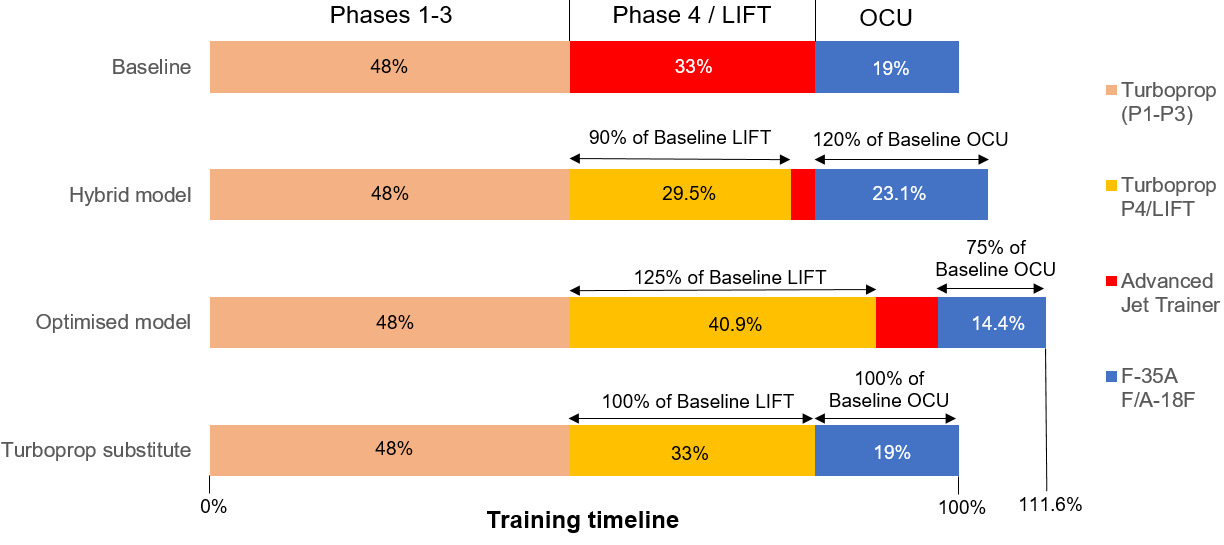
The training models are presented ceteris paribus for procurement; any future changes to turboprop or AJT fleet sizes would require re-modelling. Figure 1 shows the normalised training time per graduate for the training models from Phase 1 to OCU. The current training model (Baseline model) reflects the existing ADF Pilot Training System, covering Phase 1 through OCU, using an AJT for Phase 4 and LIFT.
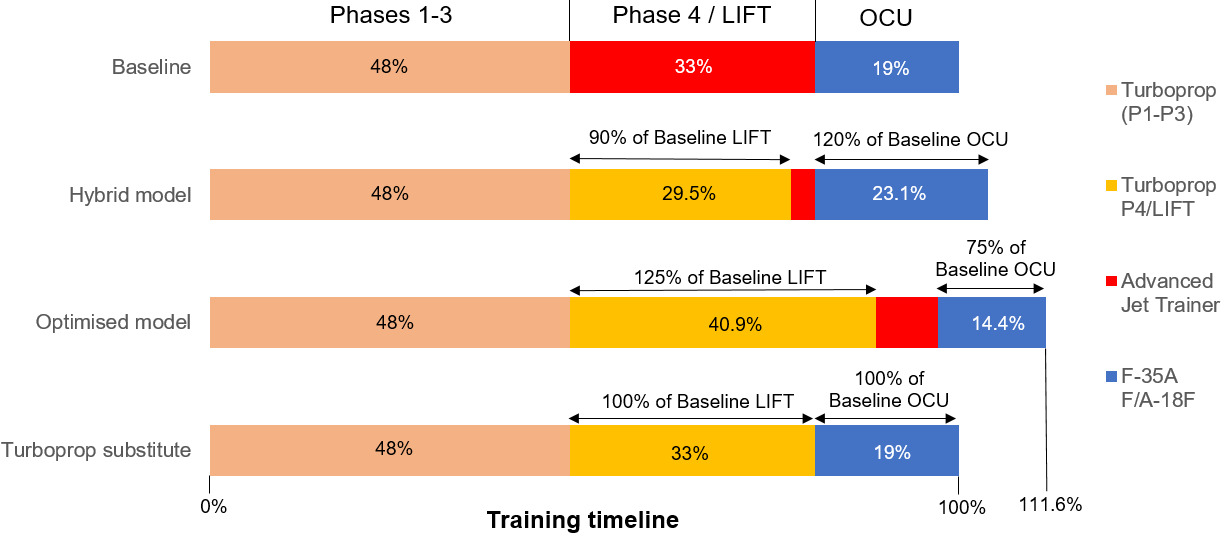
The Hybrid model retains a turboprop-heavy Phase 4 and lengthens OCU for assurance. Some 90% of LIFT is flown on a high-performance turboprop, with 10% allocated to a modern AJT. OCU expands by 20% to absorb elements not fully downloaded. The Optimised model also emphasises turboprop delivery but pairs it with a reduced OCU. A total 125% of baseline LIFT is flown on the turboprop (including additional operationally relevant sorties), 25% on an AJT, and OCU is reduced by 25% by safely downloading suitable elements into Phase 4. The last training model considers a pure Turboprop substitute model that replaces the Hawk 127 with an advanced turboprop while holding other variables constant, serving as a counterfactual.
The extended durations visible in Figure 1 reflect the longer OCU period for the Hybrid model and the larger Phase 4 volume for Optimised model. The combined increase across Phase 4 and OCU represents an 11.6% net training-time rise, which capability managers must balance against system benefit.
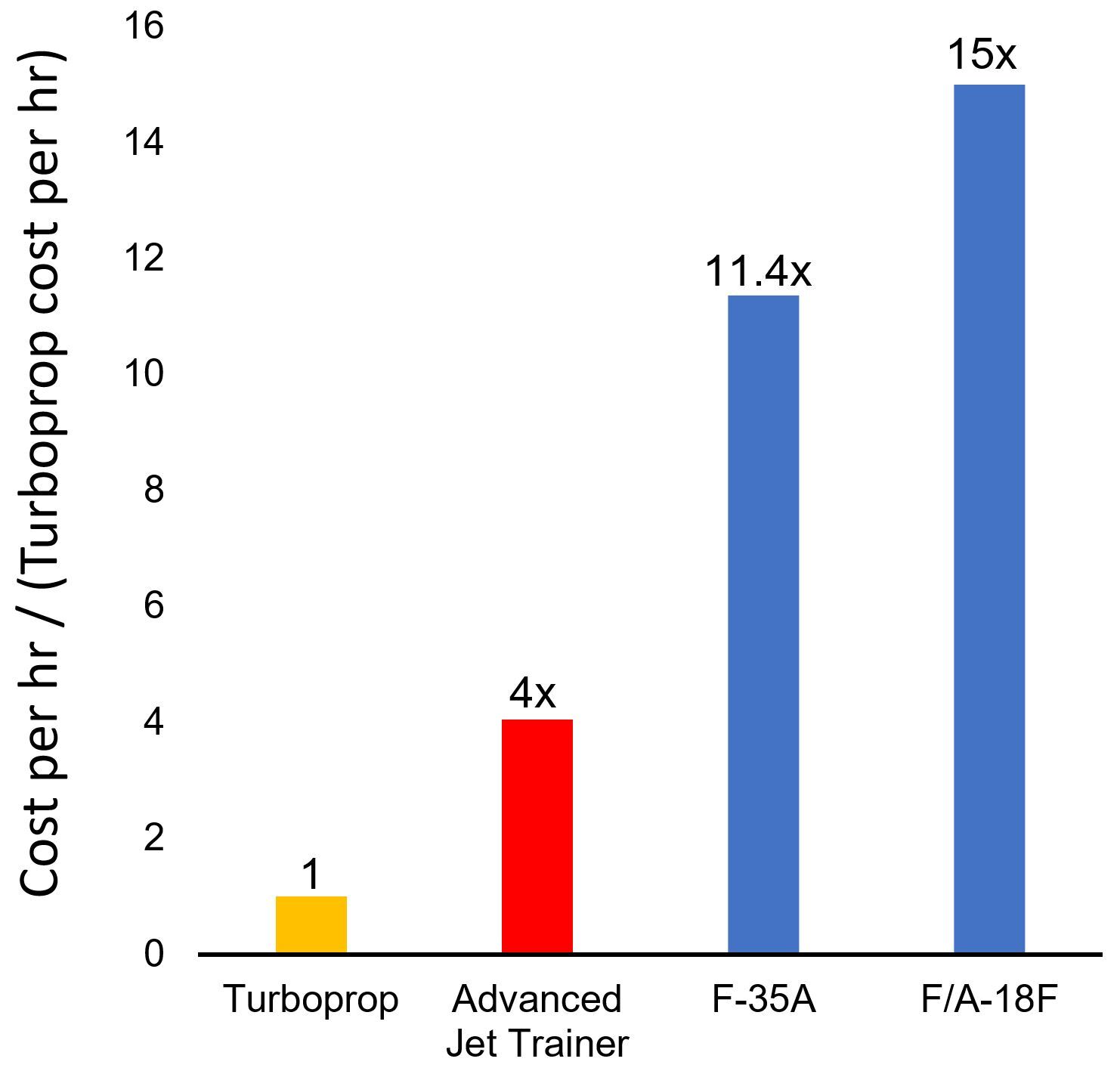
To calculate for the cost-per-graduate, we use the relative cost per hour for different platforms used in training as shown in Figure 2. All financial baselines and rate bands are anchored to the Defence PBS and extant program documentation (Australian Government, 2025), with open-source estimates used conservatively where necessary (Blenkin, 2023; Durrant, 2018; Luke Air Force Base, 2017). Relative costs are normalised with cost per hour for turboprop. Multiplying the relative cost per hour to the normalised time-per-graduate in Figure 1 could account for the relative cost-per-graduate for the different training models.
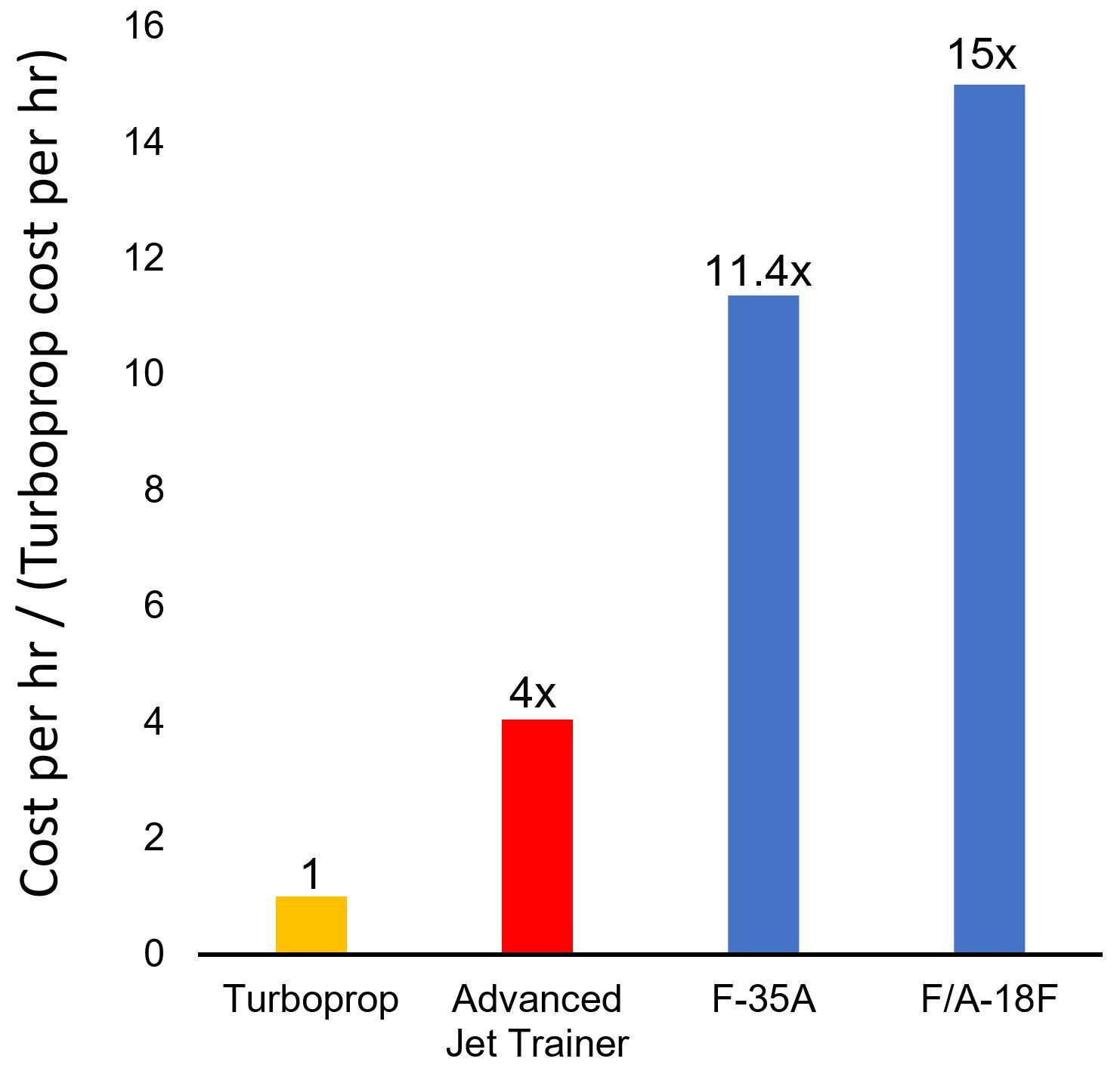
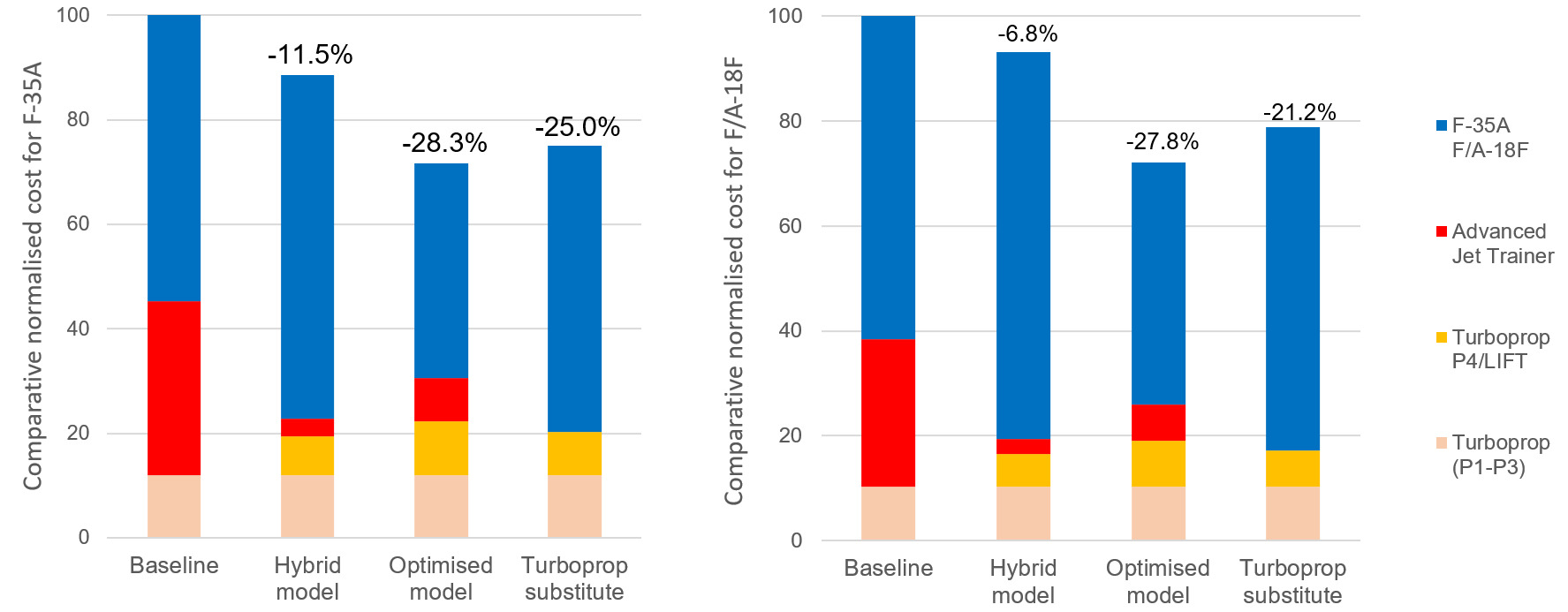
Figure 3 summarises the cost results. The Hybrid model yields cost savings of 11.5% (F-35A) and 6.9% (F/A-18F), while the Optimised model delivers the largest gains: 28.3% (F-35A) and 27.8% (F/A-18F), enabled by high turboprop utilisation, a controlled AJT share and reduced OCU time. The pure turboprop substitute still reduces costs: 25% (F-35A) and 21.2% (F/A-18F) but does not balance cost and readiness as effectively as the blended options.
Overall, high-performance turboprops can deliver most of the training value traditionally associated with jets, at far lower cost and with only modest additional time per graduate. This reduces expenditure, increases throughput, and preserves readiness.
To clarify our logic:
-
The Baseline model reflects 2025 curricula across Phases 1–3+, Phase 4 on Hawk 127 with current synthetic ratios, and current OCU durations; Red Air is embedded in PBS sustainment.
-
The Hybrid model shifts 90% of Phase 4 to an advanced turboprop, retains 10% AJT and increases OCU by 20%.
-
The Optimised model grows Phase 4 volume to 150% of Baseline (125% turboprop, 25% AJT) and reduces OCU by 25% by safely downloading suitable components.
-
The Turboprop substitute model directly replaces Hawk 127 to illustrate the delta from Baseline.
_and_f_a-18f_(right)_conve.png)
Three consistent patterns emerge:
-
The Hybrid model reduces cost with modest syllabus change. Moving 90% of Phase 4 to the turboprop and retaining 10% AJT, while conservatively increasing OCU by 20%, lowers CPG by 11.5% (F-35A) and 6.8% (F/A-18F). TPG rises by only 3.9%. This reflects the strong leverage of transferring airborne hours from jets to a lower-cost platform with embedded mission systems and LVC, while preserving key jet-only effects in AJT and OCU. Hybrid is therefore a low-risk, cost-reducing interim state.
-
The Optimised model produces the largest savings but depends on real OCU reductions. With ~125% turboprop volume, 25% AJT share and a 25% OCU reduction, CPG falls by 28.3% (F-35A) and 27.8% (F/A-18F), with TPG rising by 11.6%. These gains occur only if OCU reductions are genuine and if Red Air is properly planned and priced. Without effective OCU downloading, Optimised regresses towards Hybrid while adding complexity. It therefore requires performance-based gating.
Further balancing can produce deeper savings: for example, +150% turboprop, 15% AJT and a 50% OCU reduction with heavier synthetic emphasis yields >40% CPG reduction with <10% TPG increase. -
The pure Turboprop substitute model is beneficial but inferior to blended models. Replacing Hawk 127 entirely with a turboprop reduces CPG by 25% (F-35A) and 21.2% (F/A-18F) with unchanged TPG but does not match Hybrid or Optimised in balancing cost and readiness.
Across all scenarios, the dominant sensitivities are fast-jet flying-hour rate variance, actual OCU time-in-training achieved, and the live-synthetic balance. These shape the magnitude of savings but not the ranking: Hybrid consistently outperforms Baseline and Optimised outperforms Hybrid when OCU downloading is achieved.
Hybrid is the rational starting point: cost-reducing, throughput-enhancing and low-risk. Optimised is the aspirational end state: offering the greatest savings and throughput but dependent on demonstrable performance in OCU and synthetic integration. A pure turboprop model is not competitive because it removes the AJT component that preserves readiness at acceptable cost.
Fundamentally, sustainable improvement in aircrew generation requires cost modelling aligned to how capability is actually produced. Re-shaping Phase 4 around the lowest-cost platform mix that still preserves fast-jet-ready competencies – and treating OCU as a system-wide resource – consistently yields superior outcomes. Within that logic, Hybrid delivers a low-transition path to ~10% savings, while Optimised provides a gated path to ~28% savings. Both outperform the Baseline on a PBS-anchored, like-for-like basis, validating the central argument for Phase 4 reform.
8. Recommendations and Implementation Pathways
The analysis demonstrates that the RAAF can increase throughput, reduce cost-per-graduate and safeguard fifth-generation standards by reallocating cognitively rich but non-jet-dependent Phase 4 tasks to a high-performance turboprop, while preserving Hawk or AJT hours for the small set of training events that genuinely require jet performance. Achieving this requires a simple, disciplined and evidence-based implementation pathway that aligns training design with how capability is actually produced.
The core design logic rests on three interlocking principles. First, the jet-only envelope must remain protected so that transonic manoeuvre, weapons-related work-ups and defined Red Air roles continue to be delivered on platforms capable of safely and credibly teaching them. Second, cognitive readiness must be developed earlier and at scale using high-performance turboprops equipped with mission-system emulation and LVC, which allow trainees to rehearse decision-making, information-management and tactical execution far more frequently and at much lower cost. Third, Phase 4 must be fully integrated into the broader aircrew training ecosystem so that planning, execution and debrief cycles – and the data that support them – are consistent across live and synthetic modes.
The first step in implementation is the trialling and/or re-authoring of Phase 4 into a Hybrid model that shifts roughly 90% of cognitive and mission-system events to the turboprop while retaining about 10% of the syllabus on the Hawk or AJT for jet-dependent tasks. The event-allocation logic is straightforward: cognitive events shift to turboprop; kinematic or weapons-specific events remain on jet. Each competency block should progress from simulator to airborne LVC to live multi-ship, ensuring trainees arrive at OCU with strong cognitive foundations rather than requiring remediation. Given the mixed RAAF fast-jet fleet, a control-and-variable approach – using the F-35A stream as a stable baseline and the F/A-18F stream as the variable pathway – would enable comparative evaluation of the Hybrid model.
Successful reform depends on establishing a small, stable fourth- and fifth-generation instructor cadre responsible for re-authoring the syllabus, defining competency gates and standardising assessment across all modalities. These gates, covering information-management, prioritisation, communications discipline, decision-making under ambiguity and recoverability from error, form the contract between Phase 4 and OCU. When consistently met, they allow OCU to concentrate on high-end, collective mission integration rather than re-teaching foundational skills.
AIR5428 and F-AMTS already provide a baseline for integrated training. The next step is to scale their use so that Phase 4 routinely captures simple, high-value data such as timelines, cognitive load, and capacity signals such as task-switching indicators. These should be provided to instructors as usable insights that support adaptive coaching and early remediation, rather than as complex dashboards. This data-enabled approach preserves standards without relying on fixed hour counts.
Red Air must be treated as a planned and priced resource rather than absorbed incidentally through Hawk utilisation. Hawk (and future AJT) hours should be reserved exclusively for the jet-only subset of Red Air events, with additional vignettes delivered by contracted adversary providers at predictable points in the training year. This ensures Hawk life-of-type remains protected and removes unplanned demand from the system.
Every stage of implementation must remain inside the PBS-aligned sustainment envelope. Hybrid achieves immediate cost-per-graduate reductions by shifting volume to lower-cost platforms. Any transition to an Optimised model should follow only after demonstrated reductions in OCU time-in-training and evidence of predictable, appropriately priced Red Air demand. No savings should be credited until they are proven.
A small Training System Board should oversee rollout, maintaining a configuration-controlled data pack that captures syllabus design, usage assumptions, Red Air planning and device logs. After two Hybrid cohorts, the Board should convene a Gate-2 review to determine whether progression to the Optimised model is justified. Progression should occur only when evidence demonstrates improved graduation rates and throughput, reduced OCU duration, lower instructor remediation load, increased pre-OCU airborne experience, reliable delivery of Red Air without unplanned Hawk draw, and cost-per-graduate improvements within expected bands. If these conditions are not met, Hybrid becomes the steady-state model while refinements continue.
The transition can be executed in a deliberate two-year cycle. During the first three months, the instructor cadre is established, the syllabus is re-authored and baseline data are set. Hybrid Cohort A runs from months 4 to 12, followed by a mid-cycle review. Hybrid Cohort B runs from months 13 to 21, during which preliminary OCU analysis informs the Gate-2 decision at months 22 to 24. Only if measurable benefits are observed should transition to the Optimised model proceed.
Risk is minimised through strict protection of the jet-only envelope, the use of competency gates, two-cohort validation, planned rather than incidental Red Air, sequencing aligned to AIR5428 and F-AMTS capacity, and maintaining instructor cadre stability. This disciplined pathway ties reform to evidence and reinforces the broader trajectory Defence is already pursuing – aircrew training at a systems level, integrated synthetics and a renewed emphasis on the human dimension of fifth-generation capability.
9. Conclusions
The effectiveness of contemporary Australian air power rests not only on advanced platforms but on a training system that can produce aircrew ready for fifth-generation operations. The evidence shows that the centre of gravity in pilot training has shifted from kinematic fidelity to cognitive fidelity – the ability to manage fused information, prioritise under ambiguity and operate effectively in complex, often degraded environments (Dahm et al., 2025; Hubbard, 2023; Lemons et al., 2018). Defence’s recent investments demonstrate an institutional shift toward this integrated, competency-based approach (Australian Defence Magazine, 2025; Lancaster, 2024; Lim, 2025; Lockheed Martin, n.d.).
Within this environment, the paper has made a RAAF-specific, evidence-based case for modernising Phase 4 by reallocating cognitively rich but non-jet-dependent tasks to a high-performance turboprop with mission-system emulation and LVC, while preserving the Lead-in Fighter Trainer for transonic manoeuvre, weapons-related events, and defined Red Air roles. This is not a platform-replacement argument; it is a training-effect argument, aimed at increasing early airborne exposure, improving cognitive readiness, reducing cost-per-graduate, and protecting scarce jet hours for the operational and training tasks that require them most (Australian Government, 2025; Bridel et al., 2021).
To ensure that decisions remain grounded in evidence rather than assumptions, the paper introduced a PBS-anchored cost method that accounts for flying-hour sustainment, fleet effects, synthetic utilisation, instructor effort, Red Air provision and OCU time-in-training. These inputs are presented as sensitivity bands, not false-precision point estimates, providing a transparent framework for evaluating alternative training designs (Australian Government, 2024a, 2024b, 2025; Department of Defence, 2023).
Recognising the realities of system transition, the paper recommends a gated pathway: adopt a Hybrid model for two cohorts, instrument outcomes using AIR5428/F-AMTS data, and progress to an Optimised model only when performance criteria are met – higher throughput, reduced OCU time-in-training, improved instructor utilisation, predictable Red Air demand and measurable cost-per-graduate reductions (Australian Defence Magazine, 2025; Lockheed Martin, n.d.; Pittaway, 2019a).
The broader implication is that training realism must be re-defined. In early and mid-pipeline phases, realism is primarily cognitive; in late stages it is jet-kinematic and collective, centred on instructor-led integration at OCU and AWIC (Hubbard, 2023; Self, 2025; Woltjer et al., 2024). High-performance turboprops and synthetic environments therefore become force multipliers, expanding airborne learning volume and sharpening mission-system fluency, while Hawk hours are conserved for the irreducible jet envelope. This approach aligns with international practices, including Switzerland, Brazil and France’s restructuring, while remaining tailored to Australian force-structure, cost, and sustainment realities (Fischer, 2018; Wiltgen, 2017; Wolf, 2024).
Finally, the argument re-centres the human dimension of fifth-generation air power. No platform can compensate for aircrew who cannot think clearly, integrate effects across domains, manage ambiguity or lead teams under pressure. A training system that builds cognitive capacity early, preserves scarce jet and instructor resources for the tasks only they can teach, and measures what matters will better prepare Australian aviators for the operational realities of the coming decades. In short, by flying more, and flying smart, within an integrated, data-connected ecosystem, the RAAF can increase throughput, protect standards, and deliver the cognitively ready aircrew demanded by modern and future air warfare.
Phase 1 – Elementary; Phase 2 – Basic; Phase 3 – Advanced; Phase 4 – Lead-In Fighter Training; Red Air = Adversarial air role.
‘Fifth generation’ aircraft are defined as ‘capable of operating effectively in highly contested combat environments, defined by the presence of the most capable current air and ground threats, and those reasonably expected to be operational in the foreseeable future’ (Harrigian & Marosko, 2017). Currently fielded RAAF fifth generation aircraft include the F-35A, with fourth generation aircraft including the F/A-18F and EA-18G.