
1. Introduction
We live in an era increasingly defined by megaprojects – large-scale undertakings characterised by significant investment, vast complexity and long-lasting impacts on the economy, environment and society (Esposito & Terlizzi, 2023) – among which outer space endeavours figure prominently (Locatelli et al., 2021). For example, satellite mega-constellations such as Starlink (SpaceX), Kuiper (Amazon) and OneWeb represent large-scale space infrastructures designed to provide global broadband coverage. Prototype solar power satellites reflect billion-dollar efforts to reshape human activity in space. Similarly, asteroid mining megaprojects – still in early research stages – promise access to rare metals and fuels, with the Psyche mission of the National Aeronautics and Space Administration (NASA) serving as a scientific precursor. Contemporary space initiatives such as planetary missions like Mariner 10 (Reinecke, 2021) and NASA’s Spitzer Space Telescope (Rottner, 2019) are also ambitious megaprojects that have received scholarly attention.
Despite targeting orbital and interplanetary space, these megaprojects are firmly rooted on Earth. Space exploration depends not only on engineering but also on public–private partnerships as well as national and international regulatory frameworks. As Armstrong and Klinger (2025) put it, space is ‘made through Earthly practices’ and is ‘not so outer after all’. Space megaprojects typically require coordination among diverse actors – public agencies (for example, NASA), private companies (for example, SpaceX, Amazon) and research institutions. The Spitzer Space Telescope, for instance, involved collaboration among ‘over 1,000 individuals from 24 organizations’, illustrating how innovation emerged through the ‘reworking [of] occupational, organizational, and institutional boundaries’ (Rottner, 2019).
This growth is not limited to Western private actors alone. China has rapidly expanded its space activities through a combination of state-led and commercial initiatives, developing multiple launch sites and significantly increasing launch capacity (BryceTech, 2024). In parallel, China is advancing several large-scale satellite constellation megaprojects – such as GuoWang or Qianfan – whose planned sizes rival or exceed existing Western constellations (Pao, 2025), further intensifying congestion in key orbital regimes.
The rise of commercial actors, often referred to as New Space, poses new challenges to the sustainability of outer space megaprojects. Private-sector initiatives increasingly drive orbital activity, creating long-term challenges for the sustainability of near-Earth space. Between 2004 and 2018, the number of objects tracked by the United States (US) Space Surveillance Network (SSN) more than doubled (Johnson, 2004; Palanca, 2018), with most activity concentrated in Low Earth Orbit (LEO) within 2,000 km of Earth. However, LEO is not a uniform environment: while objects in lower LEO may decay naturally within decades, spacecraft and debris above approximately 600–800 km can remain in orbit for longer than 25 years, or indefinitely, without active disposal. For instance, a close approach in June 2024 between two abandoned satellites at ~980 km highlighted how massive derelict objects in higher LEO create a significant and ongoing collision risk for operational spacecraft. As a result, satellite conjunctions, particularly in higher LEO regimes, are expected to continue increasing as commercial deployment expands (Burgis et al., 2023).
The exponential growth of the private sector is especially disruptive for Space Situational Awareness (SSA) systems, which are tasked with monitoring the space environment to support safety. SSA systems face two major limitations. First, current tracking infrastructure cannot detect all debris in orbit. Even the advanced US SSN cannot monitor objects smaller than 10 cm, despite debris in the 1–10 cm range posing substantial threats to satellite operations (Slann, 2014). Moreover, upcoming tracking systems are unlikely to systematically monitor objects smaller than 5 cm, leaving a significant gap in orbital awareness (Muelhaupt et al., 2019).
Emerging surveillance systems are unlikely to keep pace with the growth in satellite deployments. While the US Space Fence is expected to track up to 200,000 objects (Erwin, 2017), it may still fall short of ensuring safe conditions in LEO. The US Government Accountability Office (GAO) estimates that 58,000 satellites may be in orbit by 2030 (United States Government Accountability Office, 2022). Moreover, debris measuring at least 1 cm is expected to grow steadily. According to the European Space Agency (ESA), approximately 1.2 million such debris fragments already orbit the Earth (European Space Agency, 2025). With over 350 satellite constellation megaprojects in progress, the total number of spacecraft could potentially reach 478,000 satellites (Erwin, 2023). Furthermore, the Department of Defense (DoD) does not disclose the positions of national security satellites (Cottom, 2021), hindering the creation of a comprehensive orbital catalogue. Finally, current systems are further constrained by temporal and geographic coverage gaps, which limit continuous and global monitoring of the orbital environment. No single surveillance architecture can capture the full complexity of space activities, making the integration of heterogeneous SSA systems and coordinated data sharing essential. Increasing satellite manoeuvrability and natural orbital perturbations, particularly in large constellations such as Starlink, significantly degrade orbit prediction accuracy, highlighting the growing necessity of incorporating operator-provided ephemerides to ensure the reliability of conjunction assessments. Altogether, these limitations suggest that future space tracking systems will likely be inadequate for ensuring operational safety.
This uncontrolled growth brings significant risk. Shustov (2022) highlights how the proliferation of satellite mega-constellations threatens astronomical observations by increasing optical and radio interference. Starlink satellites, for example, have obstructed ground-based views of celestial events, including the rare sighting of comet NEOWISE (Bhakare, 2021). The broader effect of these constellations on the night sky has alarmed astronomers, international organisations and Indigenous communities for whom the sky holds cultural and navigational value. More critically, these disruptions point to a systemic threat: the Kessler Syndrome. This concept – first introduced by NASA scientist Donald Kessler in 1978 – describes a self-reinforcing chain reaction in which debris collisions generate more debris, potentially rendering orbital zones unusable (Kessler, 1991). Once a hypothetical concern, this scenario has become increasingly plausible given the rapid growth of satellites, lax deorbiting protocols and limited regulatory oversight.
While LEO hosts a higher volume of satellites and debris (Bast & Krag, 2019), the long-lived nature of debris in Medium Earth Orbit (MEO) and Geostationary Earth Orbit (GEO) also poses significant, often overlooked threats that demand greater attention in space sustainability efforts. Unlike LEO, where atmospheric drag gradually removes debris, both MEO (Skoulidou et al., 2019) and GEO lack this natural disposal mechanism, allowing wreckages to endanger space operations for exceptionally long periods (Dongfang et al., 2017). Therefore, considering the growing number of plans to occupy these higher orbits (Savage, 2023), a comprehensive solution is needed to address the proliferation of objects across all orbital regimes.
Managing such a complex technological ecosystem – which includes satellites, launchers and space stations – requires an advanced expertise that currently exceeds the capabilities of private sector organisations without policy support from government (Ailor, 2006). International organisations also play a key role through the adoption of guidelines and standards to enhance safety (United Nations Office for Outer Space Affairs, 2026). Central among these policy measures is the development of Space-Traffic Management (STM) referring to ‘a set of technical and regulatory provisions aimed at promoting safe access to, operations in, and return to Earth from outer space, free from physical or radio frequency interference’ (Contant-Jorgenson et al., 2006).
STM systems are critical for preventing collisions and ensuring the safe manoeuvring of spacecraft in increasingly congested orbits (Bhakare, 2021). However, the literature highlights the considerable challenges in establishing a global governance framework that can accommodate a broad and diverse array of actors, with diverse and often conflicting objectives of multiple space actors, including governments, satellite operators and service providers (Ailor, 2006). One key obstacle is the absence of an internationally agreed-upon definition of STM, which stems in part from the concept of ‘management’ itself – implying a level of centralised control that is fundamentally misaligned with the interests and objectives of many major space stakeholders (Verspieren, 2021). As a result, pursuing a fully institutionalised STM regime may be overly ambitious at this stage. A more pragmatic alternative lies in prioritising Space Traffic Coordination (STC), which focuses on aligning shared objectives rather than imposing rigid, prescriptive measures. STC may thus serve as a more feasible initial step towards developing an inclusive and effective governance system for space traffic. Given ongoing strategic rivalries and geopolitical tensions, advancing STC appears to be the most viable interim solution, as legally binding arrangements in this domain remain politically challenging to implement (Blount, 2021).
Moreover, as demonstrated in the following section, most existing publications on STM predominantly address legal and engineering aspects – such as liability, technical solutions and debris mitigation – while paying insufficient attention to governance issues, especially regarding stakeholder coordination. This gap hampers a comprehensive understanding of how STM can be effectively managed within a complex, multi-actor environment. This paper addresses this shortcoming by asking: In what ways do various stakeholders coordinate their activities and shape the governance of STM?
To answer this question, we adopt the PRISMA or Preferred Reporting Items for Systematic Reviews and Meta-Analyses methodology to systematically review the available literature on STM. Our review is purposefully restricted to social science-related disciplines, reflecting our adoption of a socio-technical perspective on STM. Drawing on the foundational socio-technical theory of the Tavistock Institute (Trist, 1981; Trist & Bamforth, 1951), our approach views STM not as a purely technical challenge – centred on sensors, algorithms or tracking systems – but as a governance issue shaped by the interplay of institutional, political and social factors. It emphasises that technical systems (for example, surveillance networks, collision-avoidance protocols) and social systems (for example, regulatory agencies, private operators, international bodies) are interdependent and must be jointly optimised. By conceptualising STM as a socio-technical system, we shift attention from isolated engineering solutions to broader questions about how responsibilities, authority and coordination are distributed across actors (Esposito et al., 2024, 2025).
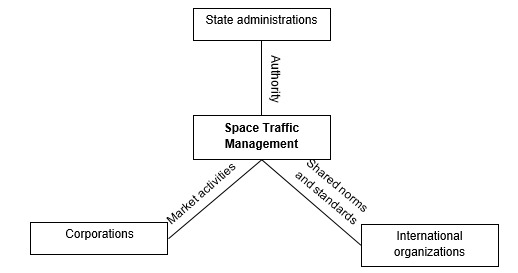
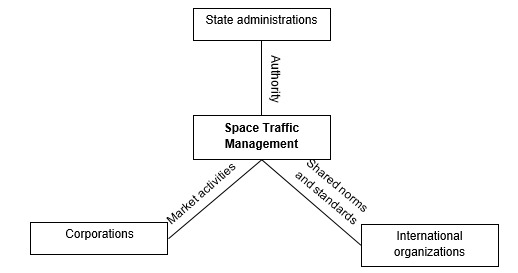
The review has identified three main categories of actors involved in STM governance: international organisations, state administrations and corporations. These actors contribute through distinct modes of coordination. International organisations promote shared norms and standards that aim to guide national policies. Although these standards are often voluntary, they can become influential when widely adopted, helping to align national efforts and foster global coherence. State administrations primarily exercise authority through regulation, licencing and oversight; however, rather than relying on fully centralised and strategically integrated surveillance architectures, many states depend on legacy military systems and increasingly procure SSA data from commercial providers to support civil safety-of-flight functions. This shift blurs responsibility boundaries, raising unresolved governance questions about whether ensuring operational safety lies primarily with states as regulators and data procurers or with operators as users of orbital space. Corporations operate through market mechanisms, developing technologies and services in response to commercial incentives, and increasingly shaping the operational landscape of outer space.
The following section, Section 2, outlines our methodological approach. Section 3 presents the findings of our PRISMA-based review, Section 4 discusses the implications for STM governance and directions for future research, and Section 5 presents our conclusions.
2. Methodology
To review the academic literature, we followed the PRISMA approach, which emphasises transparency in the inclusion and exclusion of studies. These decisions were guided by our conceptual framing of STM as a socio-technical governance issue, rather than a purely technical or engineering problem. While physical infrastructure, such as surveillance systems and collision-avoidance protocols, is essential, our focus is on the institutional, political and organisational arrangements through which STM is coordinated. Specifically, we aim to understand how STM governance emerges through interactions among public agencies, private actors and international organisations.
To reflect this perspective, we limited our search to social science-related disciplines, applying a disciplinary filter to include only publications indexed under the following Scopus categories: Social Sciences; Environmental Science; Earth and Planetary Sciences; Business, Management and Accounting; Economics, Econometrics and Finance; and Arts and Humanities. We intentionally excluded publications from technical fields such as Aerospace Engineering and Computer Science, as our goal was not to assess system performance or design but to examine governance dynamics and policy frameworks. One exception was the Journal of Space Safety Engineering, which we included due to its thematic focus on STM and its two recent special issues in 2019 and 2024 that provide valuable insights into the socio-technical dimensions of the topic. Finally, we included only peer-reviewed journal articles published in English.
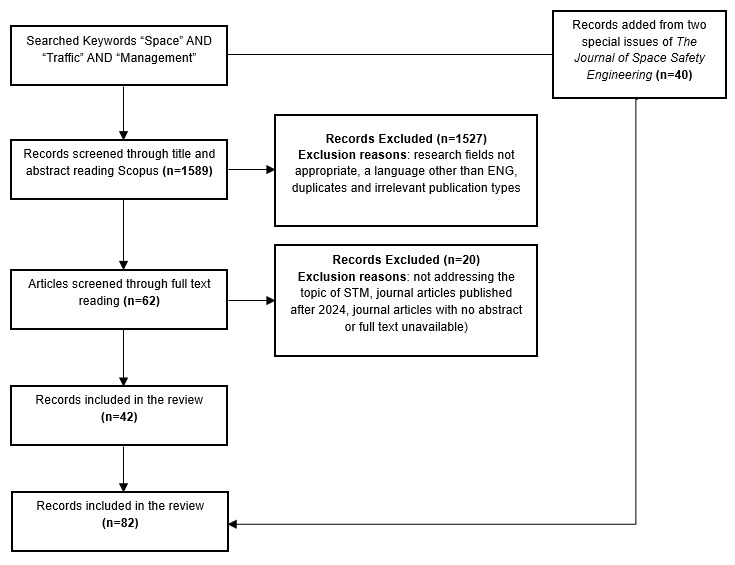
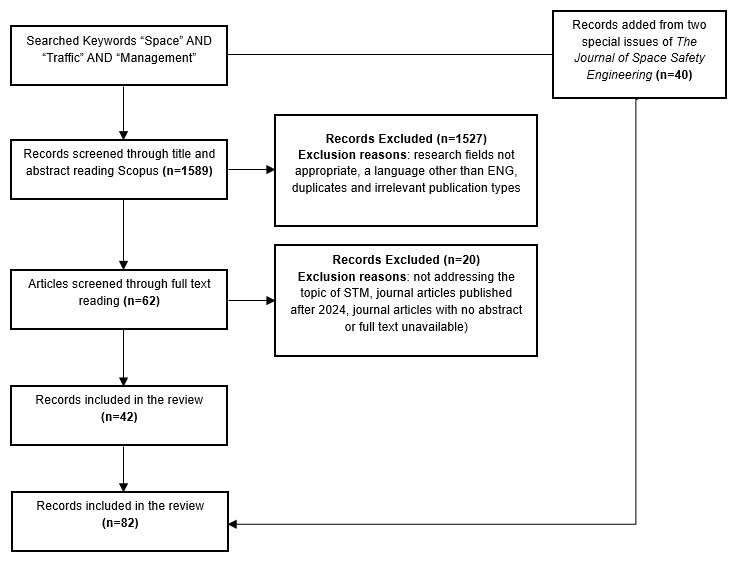
The following string was used to identify the records: ‘Space’ AND ‘Traffic’ AND ‘Management’. Only records containing the search terms in the titles, abstracts or keywords were selected. Through this initial search, we retrieved a total of 1,589 records. We removed papers that did not address governance aspects of STM, as well as those focused on unrelated topics such as terrestrial spatial planning (for example, urban or territorial planning). We also excluded non-English publications, duplicates and irrelevant publication types. After applying these criteria, a total of 62 records were retained for analysis. The remaining 62 records were further screened through full-text reading and 42 records were left. We excluded records not addressing the topic of STM, journal articles published after 2024 and journal articles with no abstracts or full text unavailable on Scopus (Figure 1). Finally, we included 40 records from two special issues of the Journal of Space Safety Engineering, resulting in a final sample of 82 records. The following two subsections provide an overview of the article sample and methodological details about the analytical process.
2.1. Overview of the sample of articles
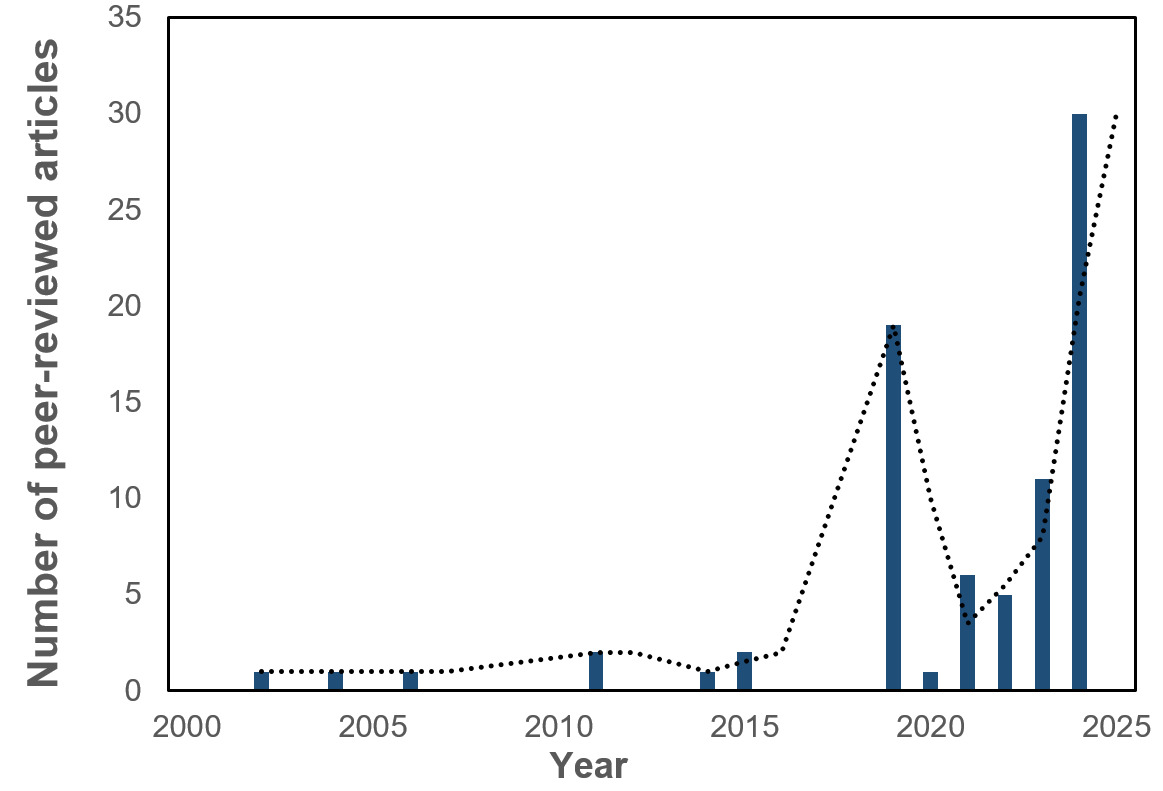
The selected peer-reviewed articles (N = 82) were published in 17 different journals between 2002 and 2024 (Figure 2). Since 2019, publications on STM have increased significantly. This surge in academic interest can likely be attributed to recent developments, including anti-satellite (ASAT) weapons tests conducted by India in 2019 and Russia in 2021, the adoption of the US Space Policy Directive-3 (SPD-3) in 2018, and the endorsement of the United Nations (UN) Guidelines for the Long-term Sustainability (LTS) of Outer Space Activities (United Nations Office for Outer Space Affairs, 2021). Equally important is the rapid deployment of large satellite mega-constellations and the growing involvement of private actors, which have exponentially increased the complexity and congestion of orbital environments.
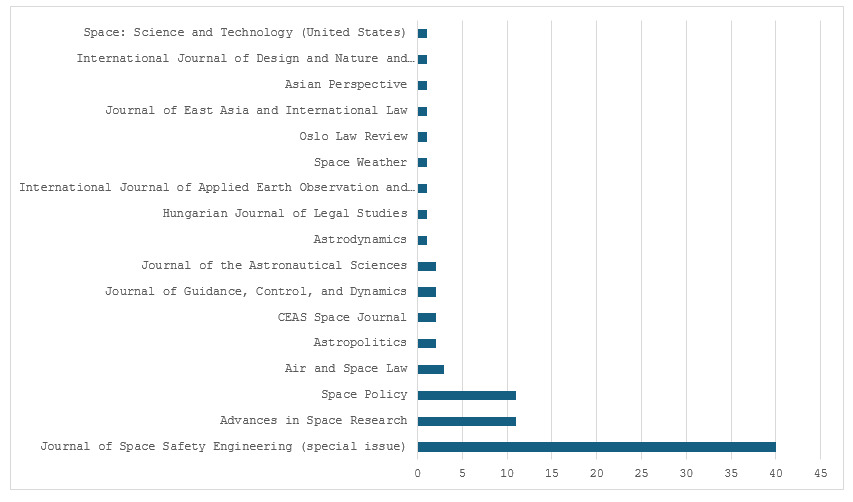
Eight journals have published multiple articles on the topic, with the Journal of Space Safety Engineering (N = 40), Space Policy (N = 11) and Advances in Space Research (N = 11) leading the field, followed by Air and Space Law (n=3), CEAS Space Journal (n=2), Astropolitics (n=2) Journal of Guidance, Control, and Dynamics (n=2) and The Journal of the Astronautical Sciences (n=2) (Figure 3). Notably, most of these journals address STM focusing primarily on legal and engineering dimensions, such as liability, technical solutions and debris mitigation. In contrast, there remains a marked lack of research on governance issues, particularly concerning coordination among relevant stakeholders.
.png)
.png)
2.2. Methodological details for the analysis of the selected articles
An inductive thematic analysis was employed to systematically code and organise the information extracted from the selected articles. Rather than imposing predefined categories, the coding process was designed to allow themes and patterns to emerge directly from the content. This ensured that the final coding framework accurately captured how governance was discussed across the reviewed literature.
The analysis began with repeated readings of each article to build familiarity and to identify meaningful units of information. An initial open coding phase followed, in which segments of text were labelled with descriptive codes representing key ideas, relevant actors or institutional arrangements connected to the research questions. These initial codes were then iteratively reviewed and grouped into broader themes based on conceptual similarity and hierarchical relationships.
The final coding structure comprises three levels of abstraction:
-
Domains, which capture broad categories of actors (for example, international organisations, state administrations, corporations).
-
Subcategories, which specify national, regional or sectoral groupings within each domain (for example, US, China, global bodies). In terms of corporate ownership, companies were classified into two primary categories: (1) listed or state-owned companies, characterised by public or government ownership, and (2) private companies, owned by individuals or privately held entities.
-
Specific actor codes, which identify particular entities or institutions (for example, Department of Defense, European Space Agency, SpaceX). Each specific actor code was assigned a frequency count to indicate its prominence in the dataset.
This structured approach enabled a detailed mapping of the variety of actors mentioned and supported the development of coherent themes directly grounded in the literature.
3. Results
The review identifies three main categories of actors involved in STM governance – international organisations, state administrations and corporations. These are examined in detail in Section 3.1. Section 3.2. details the contributions of these actors through distinct modes of coordination that structure multi-level and multi-actor interactions, while also giving rise to important governance challenges.
3.1. International organisations
International organisations with global mandates – primarily through the UN – are frequently cited actors in the literature (n=41) (see Annex: Table 1). Regional organisations also demonstrate active engagement (n=63), with ESA (n=34) and the European Union (EU) (n=21) playing a particularly prominent role. Other regional actors include the Asia-Pacific Space Cooperation Organization (APSCO) (n=1), European Southern Observatory (n=1) and North American Aerospace Defence Command (NORAD) (n=6), each contributing in more specialised or geographically focused ways.
3.1.1. Global organisations
The UN plays a central role in shaping STM governance through legal frameworks, policy coordination and standard setting. The Committee on the Peaceful Uses of Outer Space (COPUOS), under the umbrella of the United Nations Office for Outer Space Affairs (UNOOSA), was established in 1959 in response to early Soviet and American space activities. It is composed of legal and technical subcommittees tasked with overseeing five key treaties developed during the Cold War (United Nations Office for Outer Space Affairs, 2017), designed to promote peaceful cooperation and mitigate geopolitical tensions in outer space.
Beyond treaty oversight, COPUOS has developed non-binding guidelines aimed at the LTS of outer space and the reduction of debris proliferation (Takeuchi, 2011). It promotes cooperation and SSA data sharing among states, supporting the development of a global STM framework. In this way, COPUOS contributes to the normative and procedural infrastructure of international STM governance. Furthermore, COPUOS also established the Expert Group on Space Situational Awareness to produce concrete and practical recommendations aimed at enhancing operational safety, improving coordination among actors, and assessing how the UN can facilitate the exchange of SSA-related information (United Nations Office for Outer Space Affairs, 2025). The Expert Group for SSA is therefore hoped to play a role in addressing the UN’s lack of detailed guidance on data formats and implementation when engaging other international groups.
In addition, it is important to recall that, while COPUOS provides the essential normative and institutional foundation for global STM governance – including the development of international space treaties and the UN LTS guidelines – these instruments are binding on states but not directly enforceable on commercial organisations; without incorporation into domestic law, their applicability to private actors remains limited.
In addition to COPUOS, several UN specialised agencies play critical roles. The International Telecommunication Union (ITU), reporting to the UN Economic and Social Council, manages the international radio frequency spectrum and allocates orbital slots to satellite operators (Filho, 2002). As satellite constellations grow rapidly, the ITU has become increasingly involved in addressing related regulatory challenges. The International Civil Aviation Organization (ICAO), though focused on airspace, offers a regulatory and institutional model often cited in proposals for a similar global STM framework (Frandsen, 2023).
Together, COPUOS, ITU and ICAO serve as key institutional foundations for global STM governance (Contant-Jorgenson et al., 2006). While their instruments are largely non-binding, they provide the reference architecture upon which more binding or operational arrangements might be built.
3.1.2. Regional organisations
In Europe, two institutions are particularly active in STM: the EU and ESA. The EU has promoted a non-binding international code of conduct for responsible behaviour in outer space and has prioritised the development of space domain awareness through its space program (Takeuchi, 2011). The EU lacks its own surveillance infrastructure and relies on member states to contribute to the Space Surveillance and Tracking (SST) consortium. As of 2020, the consortium included national agencies from France, Germany, Italy, Poland, Portugal, Romania, Spain and the United Kingdom (Antoni et al., 2020). The EU SST system, initially restricted to EU member states, has gradually extended Conjunction and Re-entry Messages to non-EU operators, acknowledging that spaceflight safety requires broad data sharing (European Union Agency for the Space Program, 2024).
ESA operates independently of the EU but collaborates closely with it. While both institutions issued a joint declaration on protecting Europe’s space activities, they maintain separate STM-related programs. ESA’s main initiative is the Space Safety Programme (S2P), which aims to develop European surveillance infrastructure and protect Earth from space-based hazards (Kaiser, 2015).
In Asia, APSCO, with members including Bangladesh, China, Iran, Mongolia, Pakistan, Peru, Thailand and Turkey, also plays a regional role. While APSCO does not formally recognise the 1967 Outer Space Treaty, all members except Iran are parties to it, thereby indirectly binding the organisation to international space norms (Yan, 2019). APSCO is involved in developing surveillance capabilities through regional cooperation, contributing to SSA efforts in the Asia-Pacific region (Asia-Pacific Space Cooperation Organization, 2019).
In North America, NORAD – a joint US-Canadian aerospace defense command – historically played a major role in space surveillance. As early as 1969, NORAD’s SSA infrastructure was capable of tracking up to 20,000 space objects daily, highlighting its longstanding role in monitoring orbital activity and contributing to early STM practices (Cottom, 2021).
3.2. State administrations
State administrations are central to STM governance, particularly in their roles as regulators, operators of national surveillance infrastructure and key contributors to international policy (see Annex: Table 2). In the literature, the United States is by far the most frequently cited state actor (n=164), followed by Russia (n=36) and China (n=28). The literature also identifies Japan as a relevant stakeholder (n=20). Among European countries, France (n=22) and Germany (n=18) are the most analysed, with the United Kingdom (n=11), Italy (n=10) and the Czech Republic (n=4) noted. India (n=7) and Canada (n=6) also figure prominently.
3.2.1. United States
The US operates the world’s most advanced space surveillance system (Blount, 2021), the SSN, managed by the Combined Space Operations Center (CSpOC) under US Space Command (USSPACECOM). The SSN plays a key role in tracking space objects and preventing debris-related collisions. It supports a public catalogue of space objects accessible to both domestic and international users (Blount, 2021), positioning the US as a cornerstone in global efforts to mitigate risks such as the Kessler Syndrome.
The National Space Council (NSC), reinstated in 2017, coordinates US space policy across civilian, commercial and military sectors. In 2018, the NSC issued Space Policy Directive-3 (SPD-3), a presidential directive that redefined federal STM responsibilities. SPD-3 identified STM as a national priority (Antoni et al., 2020) and allocated responsibilities among NASA, the Departments of State, Defense, Commerce, Transportation, the Federal Communications Commission (FCC) and the intelligence community (Trump, 2018). It also formalised a division between civilian and military STM functions, assigning civilian STM to the Department of Commerce (DoC) and reserving military roles for the DoD (Antoni et al., 2020). To implement SPD-3, the DoC established the Office of Space Commerce (OSC), which will assume the civilian STM functions previously provided by Space-Track, including conjunction and re-entry analysis, relying primarily on commercial SSA providers seeded by the SSN High Accuracy Catalogue (HAC). This separation was reinforced with the creation of the US Space Force (USSF) in 2019, which assumed STM functions previously managed by the US Air Force.
The transformation of the Joint Space Operations Center (JSpOC) into CSpOC in 2018 further enhanced collaboration between the US and allied nations, particularly the Five Eyes partners (United States Space Force, 2019). While space policy is developed by the executive branch, its implementation depends on Congressional approval, as seen in the legislative debate over SPD-3 (Cottom, 2021). The FCC continues to regulate orbital debris compliance for commercial operators (Palanca, 2018), NASA leads debris mitigation through technical guidelines (National Aeronautics and Space Administration, 2021) and the Department of Transportation authorises launches and re-entries (Palanca, 2018), with aviation oversight by the Federal Aviation Administration (FAA) (Cottom, 2021).
With regard to the latter, institutional fragmentation over national STM responsibilities is also evident, particularly in the divisions among lawmakers concerning the selection of the most appropriate civilian agency (Hitchens, 2019). The proposed transfer of authority from DoD to DoC met with resistance from members of the US House of Representatives, who instead advocated for the FAA, pointing to its long-standing experience in overseeing and improving air safety. The decision in favour of DoC was therefore the result of a consensus (Cottom, 2021).
3.2.2. China
China maintains its own SSA capabilities (Blount, 2021), though the full scope of its sensor network is not publicly known (Kaiser, 2015). The Chinese Academy of Sciences, under the State Council, plays a central role in space environment monitoring, with observatories like the Purple Mountain Astronomical Observatory operating debris-tracking telescopes (Kaiser, 2015). Furthermore, Beijing has been developing space-based SSA systems to improve monitoring and management of its increasingly crowded LEO and GEO regions, although these surveillance assets themselves contribute to orbital congestion (Burke, 2024). China’s leadership in APSCO reflects its regional ambitions (Blount, 2021). Through initiatives like the Asia-Pacific Ground-based Optical Space Objects Observation System (APOSOS), China promotes regional data sharing and monitoring (APOSOS, 2019). However, its 2007 ASAT missile test significantly undermined global debris mitigation efforts by creating thousands of debris fragments in LEO (Takeuchi, 2011).
3.2.3. Russia
Russia has developed a substantial space monitoring infrastructure composed of radar and optical systems, largely managed by the Ministry of Defense (Palanca, 2018). Key installations include the Okno optical surveillance complex in Tajikistan and the International Scientific Optical Network (ISON), a global network of 60 telescopes across 14 countries, managed by the Russian Academy of Sciences (Kaiser, 2015). Despite its technical capabilities, Russia has also contributed to orbital congestion. Its 2021 ASAT test generated a large volume of debris, increasing the risk of future collisions and further complicating international STM coordination (Liu et al., 2023).
3.2.4. France
France contributes to STM through its national surveillance system, Grand Réseau Adapté à la Veille Spatiale (GRAVES), managed by the Ministry of the Armed Forces (Kaiser, 2015). Operational since 2005, GRAVES tracks objects in LEO, particularly between 400 and 1,000 km in altitude (Ministère des Armées, 2024). France’s SSA efforts were motivated in part by earlier incidents, such as the accidental 1996 collision involving the Cerise military satellite, which highlighted the operational risks of unmanaged orbital traffic (Johnson, 2004). Although France relies partly on US SSA data, it is investing in strengthening its independent capabilities. Dr Pascal Faucher of the French National Space Agency (Centre National d’Etudes Spatiales [CNES]) has been the chair of the EU SST since 2017, which underscores France’s involvement in Europe’s regional leadership (European Union Agency for the Space Program, 2024).
3.2.5. Germany
Germany also maintains a dedicated STM infrastructure. The Tracking and Imaging Radar (TIRA) system (Kaiser, 2015), operated by the Fraunhofer Institute for High Frequency Physics and Radar Techniques (Fraunhofer, 2024), plays a critical role in tracking and imaging orbital objects. TIRA supports ESA’s SSA programs and contributes to regional surveillance efforts. Germany’s civil space policy is overseen by the Federal Ministry for Economic Affairs and Energy, while its military space activities fall under the Ministry of Defence (Antoni et al., 2020).
3.2.6. Japan
Japan operates ground-based SSA tracking facilities, including the Bisei Space Guard Center and Kamisaibara Space Guard Center, both managed by the Japan Space Forum. These facilities were established primarily for monitoring Earth’s orbit and observing space debris (Takeuchi, 2019). Furthermore, Japan has expressed its intention to cooperate with the US on STM through information exchange (Long & Zhang, 2024) and already shares SSA data with the US Space Force under a partnership with the DoD (Takeuchi, 2019). In terms of debris mitigation, the predecessor to Japan Aerospace Exploration Agency (JAXA) established its first standards in 1996 (Takeuchi, 2019). Nonetheless, challenges in hazard reduction remain, as demonstrated by the breakup of the Hitomi satellite in 2016 [76] (Liu et al., 2023).
At the policy level, discussions on STM have been emerging in Japanese government strategies since at least 2018. Key institutions involved include the National Space Policy Secretariat of the Cabinet Office, Civil Aviation Bureau and Ministry of Foreign Affairs (MOFA). Although Japan has made notable advancements, the development of a comprehensive national STM policy is still underway. Internationally, Japan has supported the EU’s initiative to establish an ‘International Code of Conduct for Outer Space Activities’ and has actively contributed to the work of the UN COPUOS (Takeuchi, 2019).
3.3. Corporations
Corporations – both state-owned and private – emerge as key policy actors in the governance of STM (see Annex: Table 3). The literature frequently references private corporations (n=71), while state-owned or publicly traded companies are well represented (n=98). US companies dominate both categories, with 60 mentions in the private sector and 65 among state-owned and publicly listed entities. Corporations based in the United Kingdom (n=14) and Canada (n=10) also appear as significant contributors to space operations.
3.3.1. State-owned and public corporations
Three publicly owned or state-supported companies stand out in the STM literature due to their satellite operations: Iridium, Telesat and OneWeb. Iridium, a US public telecommunications company, operates a major satellite constellation (Petit et al., 2021). In 2009, an Iridium satellite collided with a Russian Cosmos-2251 spacecraft, producing a major debris field (Verspieren, 2021). The incident triggered a policy response from the US government, leading the DoD to extend space SSA services to both commercial and international stakeholders (Cottom, 2021).
Telesat, a Canadian satellite operator, has received authorisation from the US FCC (Polli et al., 2023) to deploy a constellation of 1,671 satellites in LEO (Petit et al., 2021). This illustrates the cross-border nature of regulatory dependencies in commercial satellite operations. OneWeb, a British company offering global broadband via satellite, plans to operate several hundred satellites in both LEO and MEO, further contributing to the rapid expansion of orbital infrastructure (Petit et al., 2021).
3.3.2. Private corporations
Among private firms, SpaceX plays a particularly influential role. The company specialises in both space transportation and satellite-based internet services and operates Starlink (Polli et al., 2023), one of the largest satellite constellations currently in orbit (Pritchard-Kelly, 2023). SpaceX’s plans to deploy tens of thousands of satellites have placed the company at the centre of debates over orbital congestion and safety. In 2019, ESA was forced to conduct a collision-avoidance manoeuvre after a communication failure with SpaceX’s paging system (Cottom, 2021). The incident highlighted the operational risks posed by the fast-paced expansion of private constellations and the challenges of coordinating across public and private sectors.
3.4. The governance of STM
The governance of STM unfolds across multiple levels and involves a diverse set of actors (Figure 4). At the international level, organisations contribute by promoting shared norms and standards intended to guide national policies. Although often non-binding, these standards can gain influence when widely adopted, supporting coherence across national systems. The UN COPUOS, for example, has issued sustainability guidelines and promotes the exchange of SSA data among states. However, in practice, such data sharing is often limited by national priorities, commercial considerations and the absence of a clear mandate. For instance, in the US, multiple domestic agencies and regulatory bodies face challenges in coordinating SSA activities, which can hinder consistent implementation of international guidelines. The ITU manages the allocation of radio frequencies and orbital slots, while the EU’s SST consortium coordinates the capabilities of eight national agencies to develop a shared regional surveillance infrastructure. These efforts form the foundation of international STM coordination but depend on national implementation.
State administrations operate through formal authority, managing national infrastructure and defining institutional responsibilities. In the US, the SSN is overseen by US Space Command, with STC responsibilities divided between civilian and military agencies following the adoption of SPD-3. France operates the GRAVES system under the Ministry of the Armed Forces, and Germany contributes through the TIRA radar, managed by the Fraunhofer Institute, both of which also support European-level efforts. However, national policies are not always aligned with international initiatives, as states often prioritise strategic and economic interests.
Corporations play an increasingly central role by deploying satellite constellations and providing services critical to orbital infrastructure. Their operations are shaped by commercial incentives but rely on national regulatory approval. SpaceX, operating the Starlink constellation, has become one of the most active corporate actors in space. In 2019, a collision-avoidance manoeuvre by ESA was required after a communication failure with SpaceX, demonstrating how corporate behavior can directly impact space safety. Iridium’s 2009 collision with a Russian satellite led to the expansion of SSA services by the US Department of Defense (Cottom, 2021), and Telesat’s FCC-authorised constellation (Polli et al., 2023) illustrates how corporate operations are embedded within international regulatory frameworks.
These three layers – international organisations, national administrations and commercial actors – constitute an interconnected STM governance system. While international bodies offer coordination platforms, effective governance depends on the enforcement capabilities of states and the compliance of private entities. In practice, however, regulatory enforcement is almost non-existent in several cases. Article VI of the Outer Space Treaty requires authorisation and continuing supervision of national space activities without defining the scope of such authorisation or the operational standards to be enforced (United Nations Office for Outer Space Affairs, 1967), while the Liability Convention does not regulate on-orbit conduct or assign rights-of-way (United Nations Office for Outer Space Affairs, 1972). As a result, existing regulatory frameworks largely focus on the initial licensing and launch of satellites, rather than on practical issues such as on-orbit activities, operator competence or the conduct of space operations.
Although formal governance structures therefore exist, actions by both public and private actors remain a source of regulatory gaps and challenge the sustainability and security of Earth’s orbital environment. States continue to privilege national sovereignty and economic interests. The US Commercial Space Launch Competitiveness Act (United States Congress, 2015), for instance, authorises American companies to extract space resources, testing the limits of the Outer Space Treaty. States increasingly rely on private companies for space missions, as seen in NASA’s partnerships with SpaceX for the Commercial Crew Program (National Aeronautics and Space Administration, 2025) and Artemis (Kiker, 2022). Regulatory enforcement remains inconsistent, as shown by Swarm Technologies’ unauthorised satellite launch in 2018. The 2007 Chinese anti-satellite missile test, which generated tens of thousands of debris fragments (Kelso, 2007), and SpaceX’s participation in the US military’s Space Shield program (Erwin, 2024) further demonstrate how militarisation and private-sector involvement in defence can erode trust and hinder global coordination. The future of STM governance depends not only on technical coordination but also on the political capacity to align divergent interests under a coherent and enforceable global framework.
Artificial intelligence (AI) and machine learning (ML) represent promising and essential tools for managing space traffic in increasingly congested orbital environments (Rossi et al., 2024). However, in the governance context highlighted in this paper their integration introduces both opportunities and additional challenges. AI is increasingly viewed as vital for enhancing STM capabilities particularly by improving the accuracy of conjunction alerts reducing operator workload and enabling more autonomous decision-making in crowded orbits (Bast & Krag, 2019). Public agencies such as NASA and ESA alongside private firms like Neuraspace are actively investing in AI-powered STM solutions (Manfletti et al., 2023). Yet the development and deployment of these technologies remain in early stages and face significant technical and legal barriers. A lack of accurate tracking data and limitations in computational efficiency present operational constraints (Rossi et al., 2024) while the absence of internationally agreed legal frameworks complicates coordination among stakeholders and delays the standardisation of AI applications in STM. Although AI is attracting increasing attention from public, private and international actors, effective governance will require the development of common protocols for communication and data sharing among AI-powered satellites (International Institute of Space Law, 2024). As AI continues to shape the next generation of space traffic systems international organisations, states and corporations must work together to ensure its responsible use supports, rather than undermines, the long-term sustainability of space operations.
4. Discussion
This paper contributes to the ongoing discourse on STM governance by examining how different categories of actors – international organisations, state administrations and private corporations – engage in distinct modes of coordination. This actor-centred perspective directly addresses key challenges highlighted in the existing literature, systematically reviewed using the PRISMA method.
First, our findings address the issue of fragmented coordination in a multi-actor environment, which has been widely recognised in discussions on the growing complexity of space operations. As outlined in the literature, contemporary megaprojects such as satellite constellations depend on a broad range of actors yet operate without a unified governance framework. Our analysis contributes by showing how each actor group fulfills different governance functions: international organisations promote shared norms and voluntary standards; states govern through authority by assigning institutional responsibilities and regulating infrastructure; and corporations act through market mechanisms, responding to commercial incentives while shaping operational realities.
Second, we shed light on the tensions arising from the expansion of commercial space activity. While corporations engaged in space activities may be either publicly or privately owned**,** current satellite deployments are increasingly dominated by privately owned commercial entities. As a result, STM systems must contend with the uneven capacity of regulators to monitor and manage these operations. Our review highlights how corporations – regardless of ownership structure – depend on national authorisations while, in practice, privately owned firms have increasingly challenged existing oversight mechanisms. This dynamic is exemplified by incidents such as Swarm Technologies’ unauthorised satellite launch (Blount, 2021) and SpaceX’s collision-avoidance failures. These examples underscore the urgent need to better integrate corporate actors into STM governance without compromising public accountability. Beyond regulatory and accountability risks – including lock-in effects and potential monopolistic control – private space actors can shape global norms by virtue of being first movers and dominant providers of critical infrastructure. One of the major concerns is their strategic impact, as close ties between leading companies and national security organisations allow ostensibly commercial systems, such as Starlink, to be leveraged for political and military purposes, as seen in Ukraine (British Broadcasting Corporation, 2022) and Iran (Doffman, 2026). Such dynamics risk steering the trajectory of outer space governance away from cooperative frameworks, while simultaneously rendering large-scale commercial space assets increasingly legitimate military targets, with destabilising consequences for space security.
Third, our findings reinforce the critical role of state administrations in providing regulatory and technical infrastructure, while also recognising that certain state behaviors may destabilise cooperative efforts. While private firms are advancing the commercial frontier of outer space, their activities remain heavily reliant on state infrastructure, such as the US SSN, and on regulatory authorisation for launch and operation. National policies, such as the US SPD-3 and legislation like the US Commercial Space Launch Competitiveness Act, illustrate how governments shape the rules of engagement for both domestic and international actors. At the same time, state-led practices, including ASAT tests, insufficient coordination in data sharing and the authorisation of mega-constellations, can undermine international cooperation and destabilise the evolving norms of space law by generating debris and eroding mutual trust among relevant stakeholders.
Finally, our findings support the view that international norms, while foundational, must be complemented by enforceable regulatory mechanisms and cross-sector collaboration to ensure orbital sustainability. The study contributes to the debate on global coordination and systemic risk, particularly in light of the Kessler Syndrome and the growing limitations of SSA systems. Although international organisations such as COPUOS and the ITU promote coordination through soft law instruments, the non-binding nature of their standards and uneven adoption among states limit their effectiveness.
5. Conclusions
As satellite deployments accelerate, the effective governance STM has become a critical policy issue. This study contributes to the debate by showing how STM is shaped by the interaction of three key types of actors – international organisations, state administrations and corporations – each operating through distinct coordination mechanisms. International organisations promote shared guidelines; states design and enforce regulatory frameworks while managing surveillance infrastructure; and corporations shape orbital operations through commercially driven strategies. The analysis also reveals structural asymmetries and growing interdependencies between these actors. Together, these findings highlight the need for a coordinated, multi-actor, and multi-level governance system capable of addressing the overlapping challenges of technical capacity, regulatory oversight, and political legitimacy in managing near-Earth space.
Building on these findings, three concrete policy implications emerge. First, international coordination must be reinforced through minimum binding commitments on data sharing, debris mitigation and satellite disposal, particularly among major launching states and commercial operators. While bodies such as COPUOS and the ITU play important normative roles, their voluntary guidelines often lack enforcement. The limited adherence to international norms – exemplified by China’s 2007 ASAT test and the unilateral provisions of the US Commercial Space Launch Competitiveness Act – demonstrates the need for stronger international instruments. Second, national administrations should improve inter-agency coordination to reduce fragmentation between civil, defence and commercial actors. In the US, SPD-3 aimed to clarify institutional roles, yet early conflicts between the FAA and the Department of Commerce (Cottom, 2021) reveal persistent gaps in mandate integration. Third, national regulators must be equipped to monitor and enforce compliance by private actors. Cases such as Swarm Technologies’ unauthorised satellite launch and SpaceX’s delayed response to ESA’s collision warning illustrate how regulatory blind spots can undermine orbital safety. Strengthening oversight capacities and clarifying accountability frameworks are essential to ensuring that private sector growth supports, rather than compromises, long-term sustainability.
In line with the growing importance of public–private collaboration, national agencies are increasingly leveraging commercial capabilities to enhance their operational capacity. For instance, DoC and DoD engage commercial providers to support their operational systems. The OSC launched the TraCSS pathfinder – a cloud-based system for SSA and space traffic coordination – placing orders with COMSPOC, LeoLabs and Slingshot Aerospace to evaluate LEO data and inform the operational system as part of SPD-3’s mandate (Jewett, 2024). Similarly, DoD integrates commercial data through Space Data Association (SDA) Total, Applications and Processing (TAP) Labs, which prototypes solutions with private companies, and Joint Commercial Operations (JCO), which leverages non-classified commercial data to support operational awareness, formalised via data-sharing agreements and commercial integration strategies (Bonnette, 2024).
These government–industry collaborations also reflect a broader trend: private companies are actively developing market-based solutions to support safe and efficient operations in space, complementing public efforts. For example, Analytical Graphics Inc. (AGI) has developed software that enhances situational awareness in space by conducting conjunction analysis using data from ground, space, sea and air assets (Ansys Government Initiatives, 2026). Other companies with tracking and monitoring capabilities include Boeing, Lockheed Martin, SES, Applied Defense, ExoAnalytics, Intelsat, Inmarsat, LeoLabs, Schafer Corp. and Rincon. Many of these actors have joined forces through the SDA, which promotes safe space operations by sharing tracking data among members (Pelton, 2019). Nevertheless, managing such a complex and evolving operational environment still exceeds the capabilities of the private sector alone and requires coordinated support from public policy and regulatory institutions.
Previous challenges become more complex when satellite operations extend beyond national regulatory frameworks and are subject to emerging regional governance regimes, such as the EU. Satellite operators providing services within the EU are required to comply with the proposed EU Space Act, regardless of their state of establishment (European Commission, 2025). Since the Act will apply to both EU and non-EU operators, alignment with EU requirements may conflict with the national laws of third countries. In particular, compliance with the three pillars of the Space Act may entail the disclosure of sensitive technical or operational data to EU authorities. Such disclosure obligations are likely to conflict with national export control regimes, such as the US International Traffic in Arms Regulations (ITAR). Consequently, third-country operators may find themselves caught between competing legal obligations, effectively forced to choose between continued access to the EU market and compliance with their home state’s legislation.
In light of these policy implications, several avenues for future research are evident. First, given the observed fragmentation in institutional responsibilities, future work should move beyond identifying actors to examine how governance functions are distributed and coordinated in practice – especially across civilian, defence and commercial domains. This could clarify how inter-agency coordination challenges, such as those seen in the US case, might be addressed through better-integrated policy frameworks. Second, in response to regulatory asymmetries, comparative studies of national STM frameworks could help identify more effective institutional designs and expose gaps in legal authority and enforcement capacity. Third, as private actors take on a growing share of operational responsibilities, empirical research on how commercial entities respond to public oversight – including compliance behavior and risk mitigation practices – would inform the design of more adaptive and effective regulatory strategies. Finally, our findings highlight the need to explore how interests and power asymmetries shape STM governance outcomes. The influence of dominant spacefaring states and major corporations may steer international norms or national policies in ways that reinforce structural imbalances. Understanding these dynamics is essential for designing governance mechanisms that are not only technically sound, but also politically equitable and resilient.